Science and Wireless Seminar, 27 November, RMIT

The focus of this year’s Science and Wireless Seminar at RMIT will be ‘Health and Future RF Technologies’, with an Australian Centre for Electromagnetic Bioeffects Research (ACEBR) presentation on new and emerging RF technologies and presentations by industry on 4th Generation Telecommunication and Smart Meter technologies, followed by the associated health perspective of the Australian Radiation Protection and Nuclear Safety Agency. A facilitated panel discussion will then provide plenty of opportunity for open discussion on these issues, followed by more informal conversation over coffee.

This is ACEBR’s first public event since commencing operation earlier this year.  The Centre’s Director Professor Rodney Croft will briefly introduce the Centre, after which he will welcome ARPANSA’s CEO, Dr Carl-Magnus Larsson, to formally open the Centre.

For the latest program and to register go to:

http://www.rmit.edu.au/browse;ID=oqqoku3iruy9z

Registration closes 13th November. Note that registration is free and a limited number of travel grants are available for people without travel funding.


Posted in Smart Meter | Tagged , , , | 5 Comments

Ballarat ‘Take Back Your Power’ Screening and Discussion Night – Tuesday 12 November

Ballarat Screening TBYP

Posted in Smart Meter | Tagged , , | 2 Comments

Smart Meter Bunker Scene – British Prime Minister Cameron & the ‘Big Six’ CEOs

Following the latest energy price hikes scandal in England, British Prime Minster David Cameron convenes an emergency meeting with the Big Six CEOs in the basement of BG headquarters.

Despite managing to keep £12 BILLIONS worth of spending in Smart Meters out of the debate, the jig now appears to be up…

Developed by our friends at Stop Smart Meters UK, this is a MUST SEE – ENJOY 🙂

http://www.youtube.com/watch?v=ck8dV42KxCw

Posted in Smart Meter | Tagged , , | 10 Comments

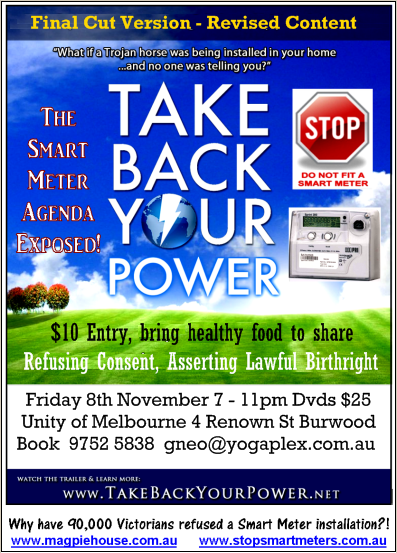
Take Back Your Power screening, Burwood, Friday 8th November

TakeBackPowerPosterNov2013

Posted in Smart Meter | Tagged , , , | 27 Comments

Smart meters: good idea or a lot of hot air? – U.K. Telegraph

If anyone needed convincing about the insecurity of Britain’s energy policy, then the news that some of our biggest wind farms were last week producing just enough power to boil a few hundred kettles should help.

It is the obvious flaw in the system: when the wind does not blow, the turbines either produce no electricity, or even become net consumers to keep themselves going. Supporters of the rush for renewables say that August is typically a month when winds are light – but no more so than June, July or September. They argue that most of the time, wind turbines produce clean energy – but the question for an advanced economy like ours is whether they produce anything like enough, especially in view of the subsidies they   receive.

However, help is at hand. We are all going to be equipped with smart meters, so we will know how much energy we are using and can adjust accordingly.   Advertisements to this effect from the big power suppliers are appearing everywhere. So, this must be a good idea, mustn’t it? Instead of trying to decipher the numbers on an ancient electricity or gas meter buried deep in the Stygian gloom of a broom cupboard, we will all have state-of-the-art digital display units telling us that someone has left the TV on, or that the daughter of the house is drying her hair upstairs.

The smart meter project will be one of the most extensive infrastructure programmes ever seen in the UK, with the aim (set by the EU) of installing them in 80 per cent of homes and small businesses – some 52 million buildings – by 2020. At one point, it was going to be compulsory to have one, but the Government thought this would be an intrusion too far. Still, with the suppliers pushing them like mad, most of us are going to get a smart meter whether we like it or not.

Earlier this month, the Department for Energy and Climate Change (DECC) announced the preferred bidders for this monumental task, which will involve the removal of millions of existing meters and their replacement with electronic devices able to communicate remotely with suppliers who can take readings at regular intervals. In theory, this should mean no more estimated readings that leave you £300 in credit with your I can see the advantages of metering. Yet I have a sneaking suspicion that it is going to cost me more, not less.

True, at the moment, trying to work out the best-value energy suppliers is almost impossible. Our home is supplied by Marks & Spencer, for goodness sake – the result of an encounter in one of their food stores between my wife and a salesman promising all sorts of goodies, including discount vouchers that we only received after chasing them up. Looking at our bill now, it is no cheaper than when we were with British Gas.

So a smart meter seems like a good idea: customers can automatically receive favourable tariffs that reward them for using energy during off-peak periods, though I can’t see many doing the laundry at 3am.

Yet this programme is going to cost some £12 billion – and the bill is to be passed on to the consumer. So if we really are to be up on the deal, we must be about to get some pretty good bargains as a result. Indeed, DECC estimates it will deliver overall benefits of £18.8 billion, giving a net gain of almost £7 billion.

Still, a number of energy experts aren’t convinced. Alex Henney, who worked in the electricity industry for many years, tells me that when a group of consultants carried out a cost-benefit analysis in 2007, they calculated a net cost of more than £4 billion. He also insists that the system being introduced here will be twice as expensive as in Italy and Spain.

“We have devised the most complex roll-out in the world, relying on suppliers to provide the meters rather than the network company,” says Henney. “This increases the cost of capital and requires an additional large database, which will lead to errors and confusion as we switch suppliers.” He adds that people could be given live information on their energy use via the internet or smartphone apps much more cheaply.

Henney told a Commons energy committee inquiry that “the project is likely to be a shambles which will have negligible consumer benefit”. The MPs, however, concluded that we should indeed gain overall, although they conceded there may be resistance. Some people, for instance, object to the idea of having what amounts to a spy in the home, believing it could be used to find out about other activities. This seems excessively paranoid – but after the data-mining scandals of recent months, who knows?

Ostensibly, smart meters’ main purpose is to make us use less energy and contribute towards a low-carbon future, along with wind turbines and other renewables. Perhaps they will – but at a cost. Germany recently decided not to follow the EU’s 80 per cent target for smart meters because it would be too costly for consumers. That is something to bear in mind when you next hear a minister promising to help people who find it hard to pay their fuel bills.

There is one thing to remember, however: when the energy supplier comes knocking on the door to install your new smart meter, you can always say no thanks, and stick with the dumb one under the stairs. Whether anyone will ever come and read it for you is another matter.

Via: http://www.telegraph.co.uk/finance/personalfinance/consumertips/household-bills/10267013/Smart-meters-good-idea-or-a-lot-of-hot-air.html

Posted in Smart Meter | Tagged , , , , | 15 Comments

Take Back Your Power Screenings – Cranbourne, Pakenham, Tynong & Garfield

What's all the fuss about flyer

Posted in Smart Meter | Tagged , , , , , | 25 Comments

All Victorians at risk from smart meter radiation – especially children

It may end up being that those Victorians (possibly 5 to 10% of the population) who have developed acute symptoms from smart meters (insomnia, headaches, ringing in the ears, fatigue, concentration and memory problems, dizziness, heart palpitations and more) are actually the lucky ones!

Why? Because they have no choice but to take immediate steps to protect themselves from the meters’ microwave emissions, as well as from emissions from a wide range of devices, including mobile phones, Wi-Fi, cordless phones, microwave ovens and baby monitors.

Despite the fact that these people may have incurred substantial expenditure, such as the cost for shielding of their home, or may have had to make sweeping lifestyle changes, such as moving house, giving up a job or even moving interstate, these are the ones who may very well, in the long-term, be the lucky ones.

It is the remaining (90% +) majority of Victorians who may be most at risk from the long-term consequences of exposure to smart meters. Yes, the majority, who feel that they can just go on with ‘business as usual’, may in fact, be the ones to suffer the greatest consequences, as they have failed to take any measures to protect themselves.

This easy to read article by Dr Andrew Goldsworthy, Imperial College, London, tells us that:

  • There are thousands of scientific papers showing that non-ionizing electromagnetic radiation causes harmful effects, such as damage to DNA, cancer, loss of fertility, brain damage, disruption of normal cell metabolism, disruption of the blood-brain barrier, neuronal hyperactivity and autism.
  • The duration of the radiation seems to be more important than its strength, with the effects being cumulative.
  • DNA damage is greater when the exposure is pulsed intermittent (as with smart meters) rather than continuous.
  • According to the WHO, radiofrequencies (including those from smart meters) are a class 2B carcinogen. Younger people are more at risk, because their brain is still growing and developing, which makes it more susceptible to damage leading to cancer.
  • The greatest damage from microwaves is when the brain is first developing in the foetus and very young child. This can lead to autism.
  • The compulsory introduction of smart meters can only contribute further to autism on a grand scale.
  • The utility company could be held legally responsible for any autistic children that a couple may have.


Read full article titled ‘How Smart Meters May Cause Autism and Cancer’:

Thank-you to Dr Goldsworthy for sending us this very important article and allowing us to use it on our website.


Posted in Smart Meter | Tagged , , , , | 33 Comments

Public Information & Take Back Your Power Screening – Oakleigh (Hughesdale), October 27th

TBYP Oakleigh

Posted in Smart Meter | Tagged , , , | 24 Comments

Smart meter returned to Powercor

This You Tube clip has been brought to our attention and we post it simply to inform you of what some people in Victoria are commencing to do as a result of not receiving any satisfactory response from power distributors about the way smart meters are affecting their health or that of their children.

Out of desperation and love for his daughter, this father, Jason, arranged to have his smart meter removed, replacing it with an analogue meter.  He then returned the smart meter to Powercor.

The act of changing a meter can be dangerous, and if this needs to occur, it should only be performed by a certified electrician.  Stop Smart Meters Australia does not encourage anyone to tamper with their meter.

https://www.youtube.com/watch?v=nUalD4qtVbI

We have also been able to obtain an extract of the letter Jason presented to Powercor.  See Letter to Powercor

Posted in Smart Meter | Tagged , , , , , , | 57 Comments

Wimmera anti-smart meter campaign intensifies – Public Meeting in Horsham, 20 October

Wimmera anti-Smart Meter campaigner Di Bell of Horsham and a group of supporters have rekindled a push against the household installation of the digital measuring devices.

Mrs Bell, an outspoken critic of the safety of the meters and a program roll-out process, has launched another ‘public awareness’ advertising campaign on the issue.

Mrs Bell, a member of a national Coalition to Stop Smart Meters, said in a letter to The Weekly Advertiser that, based on her research into the devices, she remained unconvinced they were safe.

“They (authorities) say ‘they are safe’ and will continue to do so. Based on my research I don’t believe they are,” she wrote.

“Asbestos was classed as safe too until it was later proven not to be.”

Mrs Bell said people had continued to get in touch with her since she raised personal concerns in late 2011.

She said the issue was as much about a right to make a choice as it was a health concern.

Other Wimmera residents have also written to The Weekly Advertiser with concerns. An anti-Smart Meters group has called a Horsham public meeting on Sunday at 1.30pm at Horsham’s White Hart Hotel.

All households and small businesses in Victoria are scheduled to have the new digital meters, designed to provide accurate power-use information consumer-friendly benefits, by the end of this year.

The State Government, through its Smart Meters website, provides in-depth information about the benefits and safety of the devices.

Via: http://www.theweeklyadvertiser.com.au/2013/10/16/anti-meter-campaign/

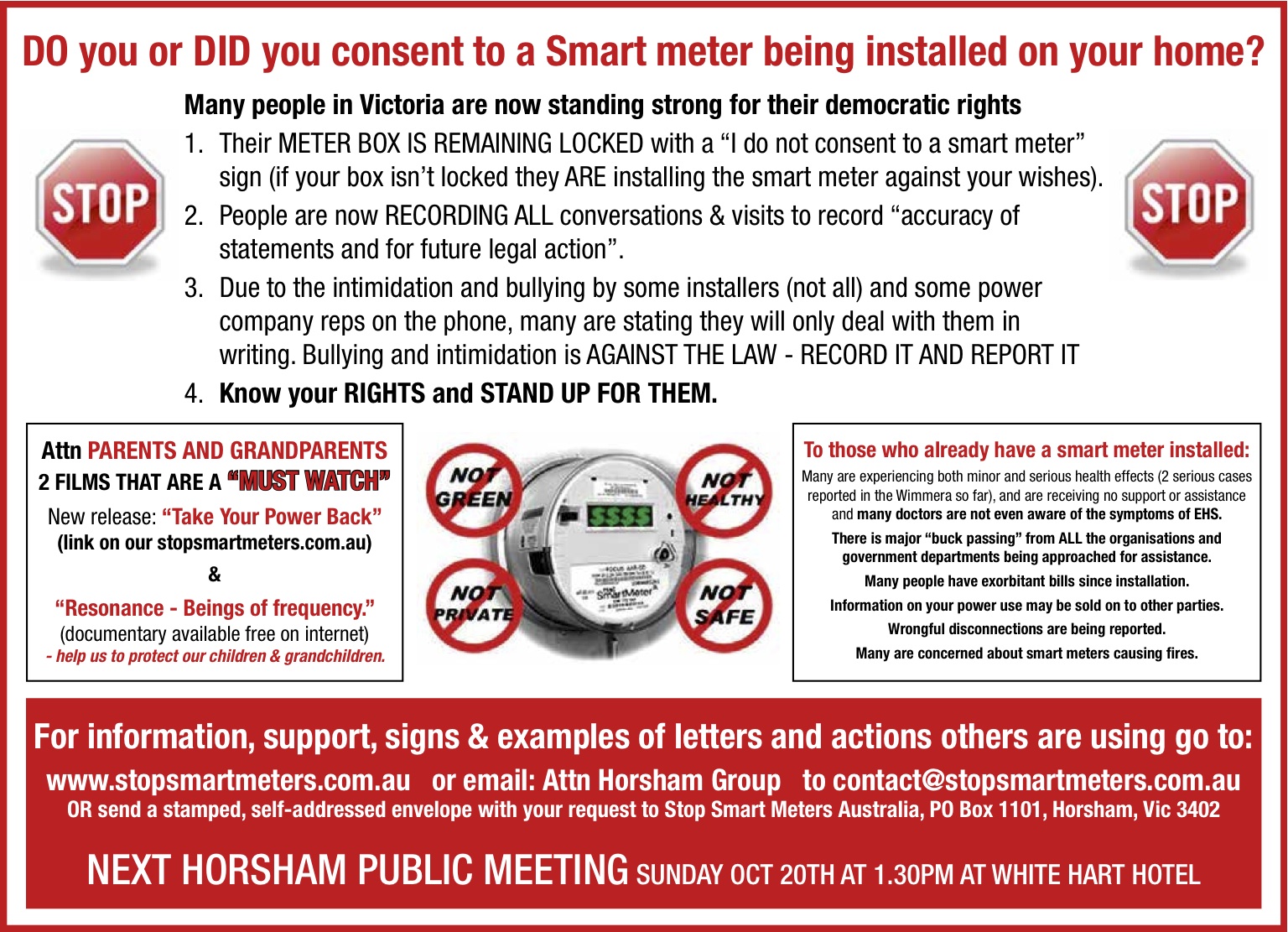
Advert in Advertiser stop smart meters 16 10 2013

This advertisement, paid for by local anti-smart meter campaigners, was published in the Weekly Advertiser, along with the above article and a letter to the editor that can be found on Page 7 at  http://issuu.com/weekly.advertiser/docs/1610backup001/7?e=6050313/5241827 :

Posted in Smart Meter | Tagged , , , , , , , , , | 11 Comments