$20 smart meter slug blows fuses

POWER distributors will reap an extra $20 million from smart meter  customers next year after yet another budget blowout.

The hike, which is over and above costs already approved, will add up to $20  to the annual charge householders with the controversial devices must pay.

The Baillieu Government blamed its predecessor for the problem, vowing it  would be tougher for electricity giants to slug customers from now on.

St Vincent de Paul Society manager of policy and research Gavin Dufty said it  was time customers saw benefits in the face of spiralling smart meter  charges.

“Enough is enough,” Mr Dufty said.

“It’s up to the industry and Government to start handing back the benefits.  Victorian households are paying for this infrastructure and almost four years in  it’s just been costs.”

Customers in CitiPower’s distribution area will be hardest hit, with the  annual meter charge rising 18.1 per cent to $127 excluding GST.

Powercor’s fee rises $16, SP AusNet’s about $8 and United Energy’s only $1.  Jemena’s fee is unchanged.

Rachel Obradovic, spokeswoman for Energy Minister Michael O’Brien, said the  Australian Energy Regulator was obliged to automatically approve the hikes  because they traced back to when the former Labor government allowed rises of up  to 20 per cent to avoid scrutiny.

The threshold has since been abolished.

“This is the last time these rules will apply,” Ms Obradovic said.

“Labor’s energy spokesperson should apologise to Victorian energy  customers.”

But Opposition energy spokeswoman Lily D’Ambrosio said the minister had  endorsed the smart meter program and would have known the price hike was  coming.

“Instead of looking at reducing cost pressures this Government is again  playing politics,” Ms D’Ambrosio said.

Distributors argued they needed more money because of higher-than-expected  information technology, communications and traditional meter costs.

Meanwhile, gas distributor Envestra threatened to defer its proposed  investment program in Victoria over a disagreement with the industry  regulator.
wes.hosking@news.com.au

Source: http://www.news.com.au/money/cost-of-living/smart-meter-slug-blows-fuses/story-fnagkbpv-1226507848375#ixzz2AwXYhhnY

Posted in Smart Meter | Tagged , , , , , | 3 Comments

Big energy users agree to switch off in peaks – NSW here they come!

ELECTRICITY demand will be cut by the amount of power needed for 50,000 airconditioners on the hottest days this summer under a deal between NSW transmission network operator TransGrid and big energy users like manufacturers, universities and data centres.

The deal – a forerunner of the kind of demand management arrangements recommended in a Senate report to be tabled on Thursday this week – means the big users are paid to switch off an agreed quantity of power for an agreed period of time on days when electricity demand peaks.

It was brokered by demand side response company EnerNOC, which aggregates and guarantees the demand reduction, and will help cut the huge peaks in demand that occur for fewer than 40 hours a year but require infrastructure spending that accounts for about 25 per cent of household power bills.

It could pave the way for similar deals with businesses and even households if smart meters are rolled out nationwide.

Smart meters collect more information about electricity use than ordinary meters. They can also send and receive information and remotely control electricity use, such as a proposal in a Senate report that households agree to savings by letting power companies shut down their appliances during peak periods of demand.

Iain MacGill, an electrical engineer and director of the University of NSW centre for energy and environmental markets, said the state government must ”bite the bullet” and commit to a potentially costly roll-out of smart meters to manage NSW’s electricity.

The Senate report, which will form the basis of the federal government’s package of power price reforms to be put to the states in December, proposed a national roll-out of smart meters.

Only about 20,000 NSW homes have the meters, compared with 1.3 million in Victoria, where the government aims to put them in every home by the end of next year.

As revealed by Fairfax Media on Wednesday, the Senate report into electricity pricing will recommend accreditation for demand side management companies, as well as a shift to ”cost reflective pricing” – allowing consumers to avoid the expensive peaks.

via Big energy users agree to switch off in peaks.

People in NSW here they come!


Posted in Smart Meter | Tagged , , , , , , , | 12 Comments

Switch off and get paid

CONSUMERS will be able to cut their electricity bills by agreeing to companies remotely switching off their appliances during spikes in demand.

The proposal is part of a package of federal government reforms expected to back ”cost-reflective pricing”. This will allow consumers to avoid peaks that occur for fewer than 40 hours every year but account for about 25 per cent of retail electricity bills.

Under the proposal, households and businesses would be able to cut their bills by choosing to switch off during peak demand times when power costs soar.

The system would be compulsory only for big users, with medium-sized users allowed to opt out and small users required to opt in if they want to switch off at peak times to reduce their bills.

The power pricing package is designed to tackle the price drivers that account for 42 per cent of projected NSW electricity cost rises from 2010 to 2013 on top of the average 9 per cent impact of the carbon tax. It will be put to the premiers on December 7 and is outlined in government-backed recommendations from a special inquiry to be tabled in the Senate tomorrow.

The ”opt in” recommendation could avoid big price rises for households that do not change their usage.

The change would require a national distribution of smart meters and would be accompanied by intensive public education and special protections for low-income households.

The report will recommend accreditation for companies offering to pay businesses and possibly households if they agree that non-essential power – for things such as pool filters, deep freezers or air conditioners – can be remotely switched off during spikes in demand.

The report is similar to the package to be put first to energy ministers on November 3, to a special business advisory forum on December 6 and to the Council of Australian Governments the next day.

They recommend more funding and clout for the Australian Energy Regulator, new rules to determine reasonable price rises for network businesses and a consumer advocacy body to scrutinise costs at every stage of generation and transmission.

Read more via Switch off and get paid.

Posted in Smart Meter | Tagged , , , , , , , | 13 Comments

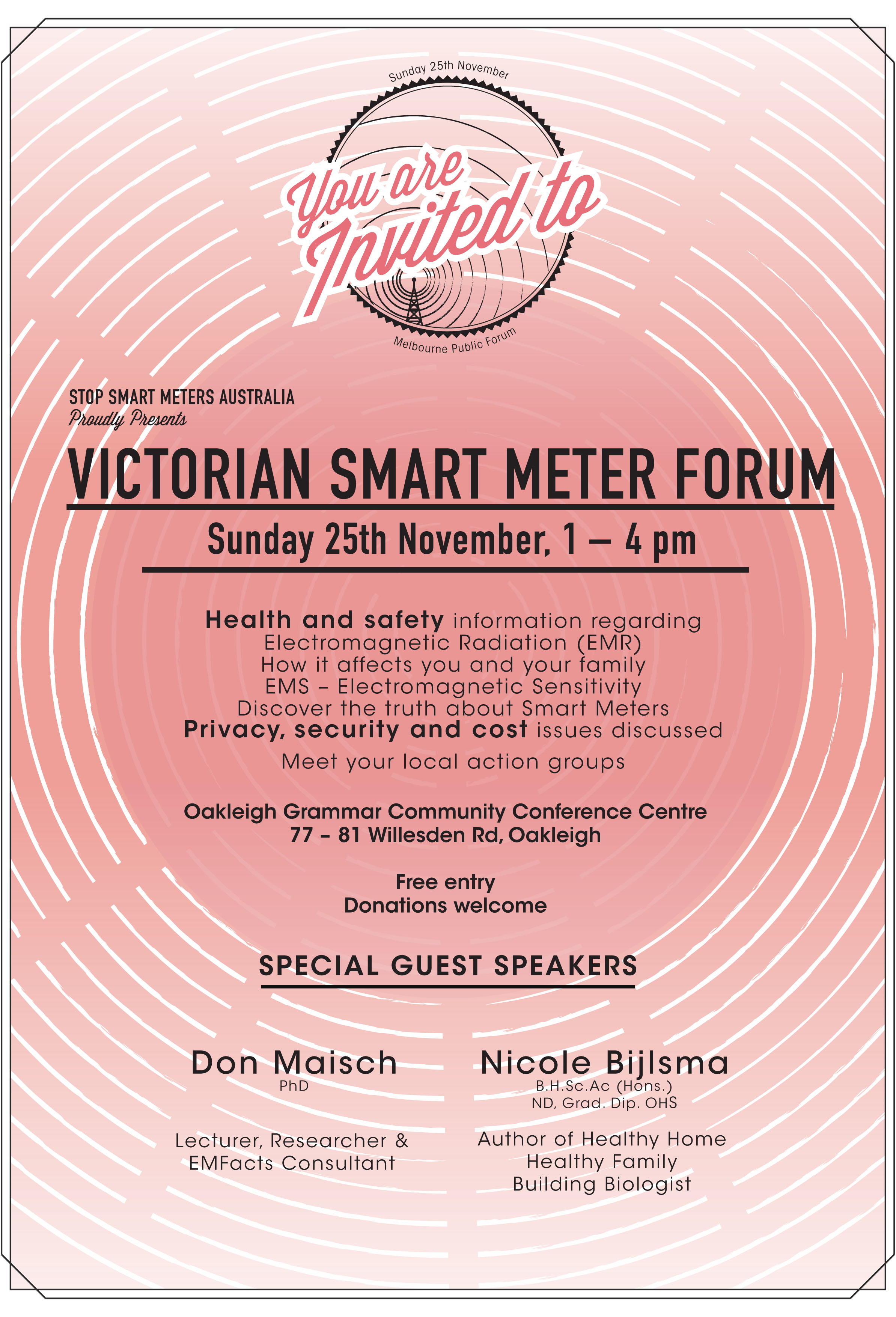
Save the date: Victorian Smart Meter Forum – November 25

Posted in Smart Meter | Tagged , , , | 17 Comments

Confirmed! The existence of a “conscientious objectors” list.

Stop Smart Meters Australia has been aware for some time, anecdotally, that some people who are refusing to accept the installation of a smart meter have been placed on a smart meter ‘refusal’ list.

This has now been confirmed in writing to a person who was intimidated and bullied by a smart meter installer.  This person made a complaint about the bullying incident to the relevant power distributor and continued to refuse a smart meter.  Consequently, this person has been placed on the “conscientious objectors list”.

The question arises, does one need to be bullied and intimidated before one can request to be on the “conscientious objectors list”?  If so, there will no shortage of people on this list….

Power distributors can no longer deny that such a list exists for people who refuse to accept the installation of a smart meter.

No matter which power distributor you are with, if you do not wish to accept a smart meter, insist that you be placed on the “conscientious objectors list”.

Related story:  Declared “exempt” from smart meter installation


Posted in Smart Meter | Tagged , , , , , , , , | 35 Comments

Glen Eira meter fears – Health – News – Caulfield Glen Eira Leader

A GROWING number of Glen Eira residents think smart meters are affecting their health, councillors say.

Councillors have revealed many residents have complained about health problems since the device was installed.

The council has now voted to seek a report into residents’ concerns.

The State Government plans to install smart meters at every Victorian home and small business by the end of next year.

It says the meters are safe and fall “well within” the requirements for electromagnetic and radio frequency emissions.

Cr Oscar Lobo said constituents were complaining of ill-health.

“People claim that they now have constantly high-pitched ringing ears,” Cr Lobo said.

“They are suffering palpitations, regular headaches, fatigue, lethargy, disturbed sleep, regular nosebleeds, pressure in the head and difficulty concentrating.”

Cr Margaret Esakoff said one resident had told her she had to confine herself to a room in her house to avoid symptoms.

Read more via HAVE YOUR SAY: Glen Eira meter fears – Health – News – Caulfield Glen Eira Leader.

Posted in Smart Meter | Tagged , , , , , | 26 Comments

Wireless meters tell snoopers when you are not home – NewScientist, 18 October 2012

CRIMINALS no longer need to stake out a home or a business to monitor the inhabitants’ comings and goings. Now they can simply pick up wireless signals broadcast by the building’s utility meters.

In the US, analogue meters that measure water, gas and electricity consumption are being replaced by automated meter reading (AMR) technology. Nearly a third of the country’s meters – more than 40 million – have already been changed. The new time-saving devices broadcast readings by radio every 30 seconds for utility company employees to read as they walk or drive around with a receiver. But they are not the only ones who can tune in, says Ishtiaq Rouf at the University of South Carolina in Columbia, and his colleagues.

The team picked up transmissions from AMR meters – operated by companies that they did not name in their paper – and reverse-engineered the broadcasts to monitor the readings. To do this they needed about $1000 worth of open-source radio equipment and information available through online tutorials.

“I consider it an embarrassment that this kind of technology is deployed with no protection whatsoever,” says Klaus Kursawe, a security researcher at Radboud University Nijmegen in the Netherlands, who was not involved in the work. “It is well known by now how to properly and economically secure communication for such a device.”

The security flaws could be a gift to technically adept criminals. Broadcasts can be read 300 metres away and the research team was able to monitor almost 500 meters simultaneously. Because energy usage often drops to near zero when a house is empty, the readings could be used to identify which owners are at work or on holiday.

There are easier ways to determine whether a house is empty, says team member Marco Gruteser at Rutgers University in North Brunswick, New Jersey. “But it’s bad practice for meters to shout out that a house is vacant while police departments recommend keeping the lights on and the mailbox empty to make your house look occupied.”

The team’s work was presented this week at the Conference on Computer and Communications Security in Raleigh, North Carolina.

Via: http://www.newscientist.com/article/mg21628875.300-wireless-meters-tell-snoopers-when-you-are-not-home.html

Posted in Smart Meter | Tagged , | 4 Comments

The same health issues experienced by others is happening to me….

I live in the Blue Mountains, N.S.W.

A smart meter –  an EDMI Mk7C ATLAS –  was installed here a  year or so back by Integral Energy and without my knowledge. Apparently it’s a trial. …… it certainly has been for me.

It sits in the meter box outside of my bedroom wall and having to move bedrooms doesn’t give me a ‘smart’ option

The same health issues experienced by others is happening to me – dizzyness, ringing in the ears and a generalised sense of ‘not quite feeling right’. I’ve also dropped to the ground on a few occasions which is no fun .

My Doctor is unable to find a cause and shrugs – as doctors often do. ‘Perfect’ he says as the blood tests come back.

I rang  Origin Electricity – my relatively new energy provider – and their technical support rang me back within the hour…. kudos to them.

A helpful bloke who tells me that my meter is effectively only a meter with a mobile phone inside it.

He accepted that I’m not interested in reassurances as to the safety of smart meters and that because I’m suffering health problems,  they’ll remove it – at no charge – over the next two weeks.

I’m suprised at both the ease and the courtesy shown and will let you know if they follow through and if a change in my health occurs.

My sympathy to all those who are desperate enough to be thinking of moving house to avoid ‘smart meters.’

David

Posted in Smart Meter | Tagged , | 12 Comments

Resident stands firm over smart meters

Warrnambool Standard, 10 October 2012
Posted in Smart Meter | Tagged , | 41 Comments

Meters not so smart?


A NORTH East building biologist says Victoria’s new smart meters should not be compulsory until their safety can be guaranteed.

Owner of At Harmony Consulting Narelle Haw has seen several people with severe health problems, including insomnia and heart palpitations, after their smart meters were switched on.

She said smart meters produced high-frequency radiation similar to wireless internet and mobile phones, and people shouldn’t be afraid to refuse having one installed.

“Until (providers) can turn around and say this technology is safe then they shouldn’t be doing it,” Mrs Haw said.

“It shouldn’t have been done in the first place, not without more consultation.”

The new digital meters are part of a major upgrade of Vic­toria’s electricity infrastructure.

North East provider SP AusNet said its meters complied with “all relevant international and Australian standards”.

But Mrs Haw said, like mobile phones, their long-term effects weren’t known.

“Mobile phones are voluntary and if people knew what their potential was perhaps they’d use them a different way,” she said.

“There is already a significant body of work that says this kind of technology affects us, we don’t know how, we don’t know why.

“The medical profession is saying there is definitely a correlation, especially for brain tumours, sperm count and blood barrier cross over.”

So far, five Victorian local councils have passed a motion saying they do not support the compulsory installation of the meters.

When asked if Indigo Council would consider passing a similar motion, acting chief executive officer Greg Pinkerton said it would have to wait until after this month’s local government elections.

Mrs Haw admitted she didn’t know how long it was likely to be before the smart meters could be guaranteed safe.

“The Australian Radiation Protection and Nuclear Safety Agency doesn’t have any standards for high-frequency radiation,” she said.

“They have no studies and nothing in regards to everyday low-levels of radiation … they don’t have the technology to do that.”

An SP AusNet spokesman said the energy company was required to replace old meters with smart meters in all small businesses and houses in its distribution area by the end of next year.

“Property owners are asked to provide free and clear access to their property for this installation to occur,” he said.

But Mrs Haw has received legal advice saying people were well within their rights to refuse.

“Our legal advice is that there’s no precedent whatsoever that says I must allow someone to walk onto my property and put a smart meter on,” she said.

Via http://www.bordermail.com.au/story/402311/meters-not-so-smart/?cs=11#

Posted in Smart Meter | Tagged , , , , , , , | 3 Comments