
Marshall Roberts is an IT specialist who has performed research on the potential health effects of wireless networking in schools because he has children and is concerned about the astronomical uptake of wireless technologies in schools. Marshall wrote a comprehensive report on this issue which he sent to the Department of Education (DoE) in Tasmania requesting answers. SSMA contacted Marshall to see if he would be willing to write a guest blog for our website because our children are being exposed involuntarily and without consent to wireless RF every day 24x 7 starting at home from smart meters and other wireless devices as well as at school (e.g. iPads, laptops, wireless routers etc.). Marshall kindly agreed and his blog follows:
What have I got to offer?
Back in May 2012, I did some reading (about 40 hours’ worth) to try to see through the noise of the “WiFi in schools” debate and come to an informed position, and I then put that position to the authorities. I am an IT consultant, so if I had any bias you’d expect it to lay with promoting IT. I am also a critical reader, who can write well enough to provide a solid introduction to the issues in a readable and even-handed way.
I’ve distilled my current thoughts into some take-home points to convince you that the issue is important enough to spend the time reading my 30+ page submission which can be found here Wireless-Networking-in-Schools. I will briefly touch on each of these points separately, and some are also expanded upon in my submission.
- the standard governing Radio Frequency (RF) exposure is outdated and selective
- Wi-Fi radiation is not trivial relative to other radiation sources
- no one is really regulating how wireless equipment is used (so you have to)
- the telecommunications industry is ‘spinning’
- we’re talking about children
The standard
It was last updated in 1998 – before the Wi-Fi brand even existed, let alone became a part of everyday life. It effectively ignores any biological effects (e.g. effects on DNA), which have been noted in thousands of studies; it is based on the assumption that RF radiation will only harm you if it heats you up too much.
All opinions and arguments aside, the fact is, while this standard has been in force, the World Health Organisation classified RF radiation as a possible human carcinogen, based on examinations of real-world (and, therefore, ‘within the standard’) use.
Wireless relative to other RF radiation
A common argument (and one that was put to me personally by Australia’s standards body) is that the radiation from wireless networks is likely to be overpowered by other sources anyway. My research turned up an independent evaluation commissioned by a major educational institution in Australia which actually demonstrated that radiation from wireless networks made up some 97% of the radiation on that campus (details are in my submission). The Wi-Fi Alliance (owner of the Wi-Fi trademark) is still keen to ‘drive adoption’ of the technology further, and it seems we may even be taking this literally, with recent plans to build cars that are mobile Wi-Fi hotspots. Wi-Fi is likely to be a growing, not diminishing, concern.
No-one is really regulating
Consider the image below which shows what happened with my submission.
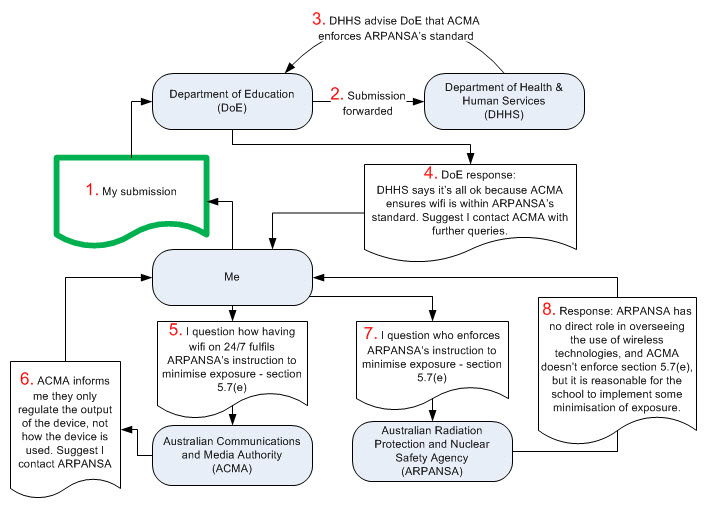
I had raised a specific point – that the Department of Education is not minimising exposure, as required by the Australian standard, in any way; wireless at our school was on 24 hours, 7 days a week. In response, responsibility for enforcing different aspects of the standards were passed around between a number of organisations with, finally, the end result being that no organisation is actually tasked with overseeing the way in which wireless technologies are used. Consider also the statements that appeared in early iPhone manuals regarding US regulations: “iPhone’s [Specific Absorption Rate] measurement may exceed the [Federal Communications Commission] exposure guidelines for body-worn operation if positioned less than 15mm (5/8 inch) from the body (eg: when carrying iPhone in your pocket).” (i.e. Apple was selling a product that was tested to comply in certain situations, but put the onus on the consumer to ensure the device was only used in those situations – if you want a copy of this statement I suggest you download the iPhone 3G document from the Mobile Manufacturer’s Forum before Apple updates it with a less-scary sounding statement). And no, it’s not just phones: the spiel for the 4th generation iPad states: “to be sure that human exposure to RF energy does not exceed the FCC, IC, and European Union guidelines, always follow these instructions and precautions: Orient the device in portrait mode with the Home button at the bottom of the display, or in landscape mode with the cellular antenna (located under the black edge at the top of the device) away from your body or other objects.” So yes, it’s very much up to us to regulate how the device is used, to make sure we’re within the standard (which itself may be seriously flawed).
The industry is spinning
If you’re really interested in the history of industry involvement in setting standards, consider this 280 paged thesis, subtitled “An examination of the manipulation of telecommunications standards by political, military, and industrial vested interests at the expense of public health protection”.
For a very quick example, this newspaper article quotes an industry spokesperson as saying that “these regulations have a significant safety margin, or precautionary approach, built into them”. The apparent misappropriation of the term “precautionary approach” is quite stunning here, given that the standard itself explicitly acknowledges the possibility of biological effects that ‘may or may not be harmful’, and then goes on to set the standard using a starting point far above the exposure levels at which biological effects are known to occur. The calls by many experts for implementers of these technologies to adopt a precautionary approach are largely due to the fact that the standard itself does not. They do have a safety margin built in, but in respect to biological effects, the safety margin has been shown in numerous studies to be woefully inadequate. A skeptical reader could suspect that the spokesperson was deliberately attempting to muddy the waters and make calls for a precautionary approach seem redundant.
We’re talking about children
Even the standards body, which has thus far clung doggedly to its outdated standard, has acknowledged that studies have shown that the standards are breached by up to 40% in experimental models of children at the standard’s maximum exposure levels that were calculated to prevent these limits being reached. As early as 1988, experts warned that children absorb high frequency EMR more readily than adults. When it comes to the use of wireless in schools, we are discussing the institutionalised exposure of a most vulnerable cohort in society – individuals without the capacity for informed consent, who are scientifically acknowledged as being more at risk to this particular threat.
You can read more of Marshall’s blogs on his pursuit for answers regarding the safety of wireless at http://www.anidealist.net/category/wifi/





 Stop Smart Meters Australia