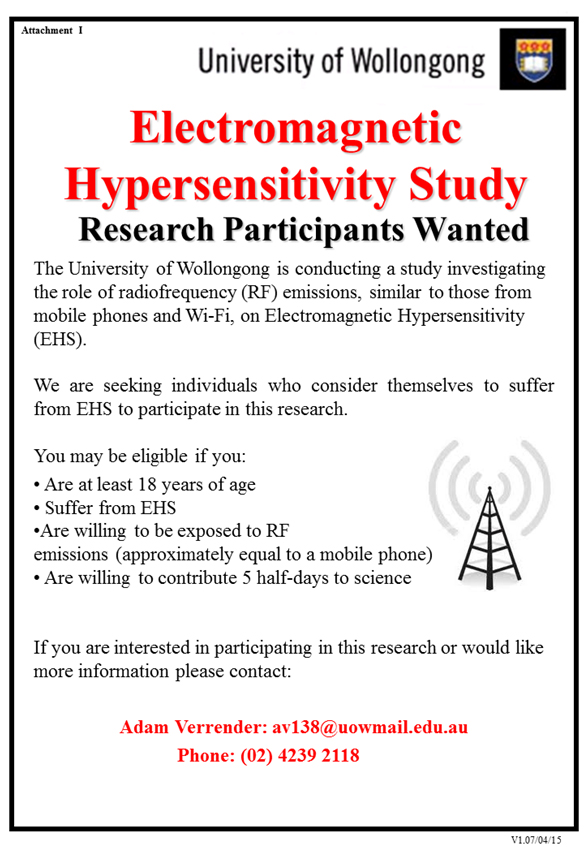
Electromagnetic Hypersensitivity study, University of Wollongong

A team of scientists at the Illawarra Health and Medical Research Institute (IHMRI), based at the University of Wollongong, are conducting a study into whether or not wireless technology makes people sick.

Wollongong Uni EHS study flyerVolunteer participants will be tested in the ‘safety’ of their home using “portable exposure devices and will be using signals that are relevant to each person’s symptoms.’’ Too bad if the participant’s home has been rendered unsafe by the installation of smart meters on, or near, their homes.

What consideration, if any, has been taken by the researchers with respect to all other sources of Electromagnetic Radiation (EMR) intruding into the home: the main culprits include mobile phone towers, neighbourhood WiFi, NBN towers and even dirty electricity? Will the team have the authority to turn off all of these EMR sources while conducting their provocation tests? It is seriously doubtful that they can and so these will most probably become unaccounted confounding influences.

Anyone who is Electromagnetic Hypersensitive (EHS) and is considering becoming involved in this study would best be advised to first read SSMA Vice President Steve Weller’s response to Rodney Croft regarding this planned study before making any commitments.

Rule number one when conducting scientific tests: remove all variables.

Will the testers know all the local sources of EMR, let alone remove them for the duration of the test? Will all participants be exposed to identical local sources of EMR, other than the EMR being applied by the tester? How can you test a person’s response to controlled doses of EMR when there are other extraneous and uncontrolled man-made electromagnetic radiation coming at the test subject from all directions?

Continue reading

Posted in ARPANSA, electromagnetic hypersensitivity (EHS), health, Research, wireless | Tagged , , , , | 16 Comments

Technical study reveals magnitude of Victorian smart meter transmissions

The purpose of the latest technical study commissioned by the Victorian government, ‘Quantifying Smart Meter RF EME Levels in Victorian Homes‘, was to confirm that the radiofrequency electromagnetic energy (RF EME) from smart meters continues to meet ARPANSA’s standard for radiofrequencies. There was never any doubt that this would be the case, given the nature of Australia’s standard. In fact, some people believe it would be more apt to refer to ARPANSA’s RF standard as a ‘cooking’ standard rather than a ‘radiation protection’ standard, given its predication on thermal effects (i.e. one’s flesh must increase by about 1 degree before emissions fall foul of the standard), and disregard for biological outcomes.

However, the study does provide interesting data on the average number of transmissions (pulses) which occurred over a one hour period at each of the 55 properties which were surveyed. The results are not pretty. Extrapolating the data shown on pages 80 – 81 of the report to a 24-hour period, the median number of pulses was a staggering 11,988 pulses per day for meters in the mesh networks, 10,992 pulses per day for meters in AusNet Services’s WiMAX network and 20,280 pulses per day for meters in the 3G network deployed by AusNet Services to reach outlier meters. The averages (arithmetic means) were considerably higher; in the case of the mesh networks, where the majority of the testing was performed, this amounted to an average of 44,314 pulses per day.

The astounding amount of traffic generated by smart meter networks, both as a result of meters being used to relay other meters’ data (in the case of the mesh networks), as well as a result of network ‘chatter’ across all networks, makes a mockery of power distributors’ previous attempts to mislead consumers into believing that their meter only transmitted at such times as their own household data was being polled. Typical of the distributors’ claims were statements such as “During the course of a day the transmission time is spaced over 4-6 transmissions“. Really?! Certainly, there were large differences in the number of transmissions per site; page 80 of the report shows that the average mesh transmissions per hour ranged from 98 through to 15,396 transmissions per hour, representing a worst case outcome of 369,504 transmissions per day; average WiMAX transmissions ranged from 52 through to 66,092 transmissions per hour, representing a worst case outcome of 1,586,208 transmissions per day; and average 3G transmissions ranged from 252 through to 176,201 transmissions per hour, representing a worst case outcome of 4,228,824 transmissions per day. Difficulty in establishing communications was the reason ascribed to the meters in the 3G and WiMAX networks which had exceptionally high numbers of transmissions.

Victoria’s networks appear to be generating even larger volumes of traffic than revealed by previous studies. Prior to this latest technical study, which was completed by Perth-based Total Radiation Solutions, Australian authorities had only examined the traffic profile of a single (!) smart meter. However, according to information that California-based Pacific Gas and Electric (PG&E) was required to file in court, which referenced 88,000 deployed meters in a mesh network, scheduled readings of six times per day resulted in a median of 9,600 transmissions per day (see pp. 3-5, http://takebackyourpower.net/wp-content/uploads/2012/04/Smart-Meter-Health-14000-to-190000.pdf). A worst case scenario resulted in 190,000 transmissions per day. PG&E use the same technology (from Silver Spring Networks) as deployed by Powercor, CitiPower, Jemena and United Energy in Victoria for its mesh networks, and by Horizon and Western Power in WA (for its Solar City program).

Although smart meter transmissions are extremely brief, it is the pulsed nature of RF which much of the scientific research sees as impacting on biological processes. In consequence, the magnitude of transmissions, across all networks, is highly concerning. The study also recorded instantaneous values, as well as showing the values averaged over a six minute period, which is the time period over which ARPANSA’s RF standard requires smart meter emissions to be assessed. The resulting figures, shown in Tables A – C of the report for the highest six-minute average, graphically demonstrate how this approach seemingly reduces the significance of emission levels.

The study trotted out the obligatory studies purporting to show the RF burden that modern householders are typically exposed to, in comparison to RF from a smart meter. However, this ignores the fact that the public has the right to determine their own exposure levels in regards to many of the items listed …this is hardly the case with 24/7 smart meter emissions. It is also irresponsible to suggest that because many householders have already chosen to saturate themselves in a (Group 2B) possible human carcinogen, that ‘just a bit more’ won’t hurt; isn’t this akin to the perverse logic of a drug or alcohol addict reasoning that just one more shot/drink won’t hurt? See ‘A Critique of the New Zealand Report: Health and Safety Aspects of Electricity Smart Meters’ in relation to one of the studies referred to in the report: http://www.emfacts.com/download/New_Zealand_critique3.pdf

Ambient background levels of RF levels were also conducted inside and outside of properties. These measurements excluded smart meter emissions. Tellingly, although in general the background levels exceeded the levels created by smart meter emissions, this was not always the case; in some instances, smart meter emissions represent the dominant RF exposure source within the home. However, no consideration seems to have been given to the fact that background levels of RF radiation in Victoria have already been skewed by the introduction of smart meter networks. For instance, all the data collected from the mesh networks’ Access Points is fed into existing telecommunication services (using the frequencies deployed by these services) to make the backhaul journey to electricity distributors. How much lower would background levels across Victoria be if this large body of transmissions was removed, thus further accentuating the RF footprint of smart meters?

The authors of the study conclude that RF EME levels from the smart meters surveyed were significantly below the general public exposure limits specified by the Australian Radiation Protection and Nuclear Safety Agency (ARPANSA). The observation was made that “In general terms, the levels of RF EME from the smart meters found inside the home were typically hundreds if not thousands of times below the Australian standard.” This offers cold comfort to Victorians; 40% of the world’s population has the benefit of protection which is ten to hundreds, if not thousands of times, more rigorous than the ARPANSA standard.

Read the report Quantifying Smart Meter RF EME Levels in Victorian Homes here.

Posted in Smart Meter | Tagged , , , , , , , , , , , , , , | 22 Comments

WiFi Backlash Trend Accelerating

Cafe owners in Sydney are realizing that “Free WiFi” comes at a cost. As The Syndey Morning Herald reports, cafes are starting to limit or ban WiFi so that people will actually have real interactions. It’s economic too – allowing one customer to purchase a $3 coffee and take up a table for five for hours on end is simply not good business practice.

As the health effects of microwave radiation come into the mainstream, this trend will only accelerate. WiFi will become just like smoking – once a ubiquitous presence in all cafes/restaurants and now something that is socially unacceptable.

You can read the full article here:

“The love affair between coffee shops and laptop-wielding customers may be dying out as coffee shop owners revolt against Sydneysiders’ demand to be wired up.

Wi-Fi backlash is a trend accelerating among coffee shops, bars and restaurants, where a failure to see the benefits of Wi-Fi-induced turnover is encouraging many owners to restrict Wi-Fi or ban it.”

WiFi Backlash Accelerating

The cafe of the future won’t have WiFi. Hemingway’s Manly manager Theo Gibson is a trendsetter. Photo Credit: Janie Barrett


WiFi Backlash Accelerating Less EMF

Just like Faraday Cafe, which opened last summer, Hemingway’s Manly is a pioneer in moving us toward a healthier society.  Photo Credit: Janie Barrett

Via: http://www.emfanalysis.com/wifi-backlash-trend-accelerating/

Posted in Smart Meter | Tagged , , , | 8 Comments

Prostituting Science – The classification of bona fide physiological disorders as psychogenic illnesses for political gain

A monumental and perhaps the most inclusive work ever on MCS and EHS.   Pelda B. Hyman, New York.

In presenting a PS Coverhost of the non-communicable diseases that currently plague our society not simply as diseases of civilization but as by-products of that civilization’s reliance on chemo- and electrowizardry, Prostituting Science takes up where Silent Spring left off.

Prostituting Science documents authoritative evidence for such an aetiology for a number of contemporary disorders ranging from asthma, migraine, diabetes, obesity, rheumatoid arthritis, lupus and cardiovascular disease; through ADHD, autism, Alzheimer’s and Parkinson’s diseases, depression and schizophrenia; to chronic fatigue syndrome, multiple chemical sensitivity, and electromagnetic hypersensitivity.

In addition to mustering a formidable assemblage of scientific data, Mrs Crumpler documents her own family’s descent into disabling Chronic Fatigue Syndrome (CFS), Multiple Chemical Sensitivity (MCS) and Electromagnetic Hypersensitivity (EHS) as a consequence of heavy pesticide exposure. Here, too, is all the evidence you’ll ever need to convince the sceptics that these are bona fide physiological disorders, as well as an effective treatment protocol for recovery.

As the title denotes, Prostituting Science also explores the paradox whereby the more that is known of a physical aetiology for these disorders, the more widely accepted have become allegations of psychogenesis. Within this context are also recounted gross abuses of the civil and human rights that other citizens of a representative democracy tend to take for granted.

Diana Crumpler trained as a teacher-librarian and taught in Victorian schools until 1984, when she was forced to retire due to ill-health. A career change was prompted by the eventual diagnosis of MCS and EHS. For the past 25 years she has been one of Australia’s foremost writers on MCS and EHS and the effects of chemicals on both human and environmental health. Her first book, Chemical Crisis, won widespread acclaim in Australia, North America and Great Britain.

For those who are interested in purchasing a copy of this informative book can do so by clicking on this link: PS order form on flyer

Posted in Smart Meter | Tagged , , , , , , , , , , , , , | 1 Comment

Do smart meters cause house fires? Evidence of Industry corruption in silencing this issue

In conjunction with the ‘Take Back Your Power’ film, Brian Thiesen explores in-depth how smart meters cause fires and the industry corruption silencing this issue.

From manufacturer savings by using cheaper and fewer parts and four different causes of arcing alone, to real world environmental impacts on the safe functioning of smart meters and poor installation, Brian outlines a multitude of things that can go wrong.  So-called ‘rigorous testing’ in the factory does not mimic the environment in which the smart meter is installed.  Nor does it take into account in any way, the dangerous items situated close to a smart meter, that could turn a meter fire into a neighbourhood demolition zone.  Watch the video to see how replacing your smart meter much more frequently than was necessary with an analogue meter, will increase the fire risk years down the track when we start to lose sight of this issue.  Watch also for the warning sign that your smart meter has just triggered a fire that may not yet be visible to you.

Brian shows newspaper and online reports about a number of smart meter fires, including some in Australia.  While Australian smart meters are different in appearance to the US smart meters, many Australian smart meters are manufactured by the same manufacturer of smart meters that has been involved in-house fires in the US.

Brian then turns his attention from the cause of smart meter fires to the coverup of smart meter fires, quoting one authority as saying, “I think ratepayers will thank us for this” (doing nothing about addressing the smart meter fires).

The film ends with a promotion of Take Back Your Power which also covers the fires issue, along with other concerns about smart meters.  Stop Smart Meters Australia has a limited number of copies of Take Back Your Power DVD available for sale.  Click on the Take Back Your Power link in the sidebar on the right of your internet browser screen to secure your copy.

Posted in Smart Meter | Tagged , , , | 7 Comments

Victorian Government releases farcical smart meter technical study

Last year, the Victorian Government announced it would conduct a health audit on smart meters.

See: https://stopsmartmeters.com.au/2014/07/16/herald-sun-reports-of-illness-prompt-audit-of-smart-meter-radiation/ and

https://stopsmartmeters.com.au/2014/04/19/media-release-victorian-governments-smart-meter-health-audit/

This ‘health audit’ transformed into a “technical study”.  It is obvious that the Government came to realise that a health audit would come up with results that contradicted government propaganda that microwave emissions from smart meters have absolutely no impact on people’s health – thus it was changed to a technical study to demonstrate that smart meter emissions meet Australian standards.  We know that smart meter emissions comply with the ARPANSA (Australian Radiation Protection and Nuclear Safety Agency) standard – that is not the issue.  What a waste of $200,000 of taxpayers’ money!!  See: http://www.pressreader.com/australia/herald-sun/20150703/281792807686882/TextView 

The recent Victorian technical study looking at smart meter radio frequency (RF) emissions is a distraction and a sham because it does not look at the health problems being raised by those claiming to be impacted. There is an assumption being made by authorities that Australia’s RF Standard protects health from all possible effects.  The reality however is that Australia’s RF Standard is only designed for short-term exposures and protects against known thermal effects, which includes tissue heating that can result in shock and burns. The RF Standard does not provide protection against non-thermal effects – these effects are known by the scientific community but the mechanism by which the effect occurs is uncertain so they have not been considered or included in the Standard. The International Commission on Non-Ionizing Radiation Protection (ICNIRP) has acknowledged that there could be a vulnerable portion of the population who may not be protected by current RF guidelines. Australia’s RF Standard is based on 1998 ICNIRP Guidelines.

To relate known biological effects to health outcomes requires medical expertise which is absent in ARPANSA, a serious deficiency that must be rectified if we are to have confidence in the scientists who are in charge of protecting our health. There are literally 1000s of scientific papers that demonstrate biological effects such as DNA damage, altered gene expression, altered protein activity, cellular damage etc. at levels well below what our RF standard suggests is not harmful. It is also interesting to note that the radiofrequency electromagnectic fields from wireless devices that are used as a comparison with smart meter emission levels (WiFi, mobile phones, baby monitors) were classified as being potentially carcinogenic by the IARC in May 2011.

The biggest problem that we are being faced with today is the lack of real scientific investigation; this allows authorities to say there is no established evidence of harm. One has to look first before harm can be determined. Unfortunately, it appears Science has become politicised and corrupted by both Government and Corporate self-interests. Wireless communication is a multi-trillion dollar industry that is also used heavily by the military so don’t expect to hear the truth on this issue any time soon.

For those people who have developed Electro-hypersensitivity (EHS) since being exposed to smart meter emissions, and for an increasing number who have become substantially disabled, this ‘technical’ study fails to address any of their health issues.

As a matter of urgency, for people whose health have been severely impacted, procedures need to be in place for the removal of RF cards from smart meters.

Perhaps a letter/email to your local Member of Parliament and to Victoria’s Minister for Energy and Resources may assist with this….


Posted in Smart Meter | Tagged , , , | 37 Comments

Can smart meters cause house fires?

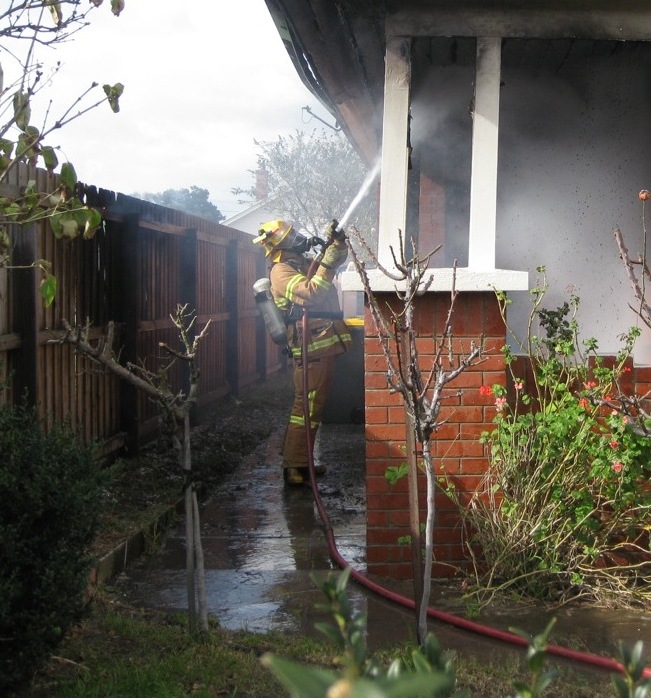
burned meter removedIn yet another recent house fire, the electricity distributor, as usual, wasted no time in racing to the scene to remove the burned out smart meter. What’s the rush?

Gee, I’m sure the property owner is very grateful to the distributor for being so quick off the mark to remove that potentially dangerous smart meter. They wouldn’t want the meter left there to go up in flames yet again, would they?

And I’ll bet the fire investigators are pleased to be spared the effort of investigating one of the possible causes of the fire, now that the evidence has been hastily removed.  It can be tricky to get your mind around how those high tech electrical devices connected to old wiring can cause fires.

Just as well the house is now uninhabitable and doesn’t need electricity supply. I suppose it would take a lot longer to get a meter installed if you requested one.firefighter

In the same area some time ago the power distributor was not quick enough to beat the photographer to the scene.

You have to get to the property before the smoke dies down if you want to beat the power distributor to remove the evidence.

burned meter


Related story: In Texas there has recently been a lawsuit about the unlawful dismissal of an electricity company employee for testifying in a separate hearing about Landis and Gyr smart meters catching fire.  Landis and Gyr brand smart meters are commonly deployed in Victoria.

Photos supplied by Oscar McG.


Posted in Fire, Power Company, Smart Meter | Tagged , | 24 Comments

Mobile Phones and WiFi are a “Serious Public Health Issue” – Canadian Parliamentary Report

OTTAWA, June 18, 2015 /CNW/ – Cancer, infertility, and learning disabilities might be caused by our cell phones and WiFi, according to a new Parliamentary report.

The microwave radiation from our little wireless devices is now a “serious public health issue” according to the report delivered Tuesday by the House of Commons Standing Committee on Health (HESA).

The unanimous report recommends Canadian doctors be taught to recognize the symptoms associated with using common wireless devices.

It also recommends parents be taught the risks of wireless radiation to ensure their families are safe at home and at school.

The Committee heard from wireless industry representatives as well as international scientists working on the health fall-out from our increasingly wireless world.

The Conservatives, Liberals, and NDP agreed that Health Canada has left Canadians at risk by ignoring or dismissing the growing evidence that shows our favourite devices like tablets and smart phones may be harmful, especially to children.

During the hearings four international experts testified that Health Canada is “either unwilling or not competent” to judge current scientific evidence that wireless radiation is harmful to our health.

“This Committee finally gave a voice to the scientists,” said Frank Clegg, former President of Microsoft Canada who is now CEO of Canadians for Safe Technology (C4ST).

“It reached across Party lines to tell Canadians we deserve to be protected. Health Canada has to stop hiding behind the worst countries on this issue, and instead catch up with countries like France and Belgium where you can’t market a cell phone to children anymore, or expose children to Wi-Fi in a daycare,” said Clegg.

The committee also recommends that federal workplaces recognize employees who have developed electro-hypersensitivity.

Report recommendations can be found at: www.c4st.org/HESARecommendationsFull

Via: PR Newswire

A copy of the full report can be found at: http://www.parl.gc.ca/Content/HOC/Committee/412/HESA/Reports/RP8041315/412_HESA_Rpt13_PDF/412_HESA_Rpt13-e.pdf


Posted in Smart Meter | Tagged , , , , , , , , , | 18 Comments

Smart meter rollout is linked to a rise in disconnections

VICTORIA’s electricity smart meter rollout has been linked to a rise in disconnections.

And fees to pay for the rollout have also pushed up power prices, putting a strain on low-income households, a state inquiry has been told.

Annual disconnections over unpaid bills have more than doubled in five years. Last financial year, 34,448 residential customers were cut off.

The Consumer Action Law Centre has recommended distributors be forced to check on householders and assess their circumstances before acting.

“We are particularly concerned … there is the potential for households to be disconnected in greater numbers,” senior energy policy officer Janine Rayner said.

Retailer Simply Energy has told an Essential Services Commission review of financial hardship arrangements that smart meters were one of the reasons for more cut-offs.

The technology can be used to pull the plug remotely, and “this alone will have increased disconnection rates over the last two years or so”.

Simply Energy noted it had also experienced a “significant rise” in those applying to hardship programs or failing to pay bills because of rising prices.

Charges beyond retailers’ control — including the cost of the smart meter rollout — were among the reasons.

Karen Collier, via Herald Sun (Page 2, 18 June 2015)

Posted in Smart Meter | Tagged , | 10 Comments

Melbourne doctor fears link between mobile phone use and brain cancer

A leading Melbourne doctor is blaming mobile phones for an escalation in brain cancer.

Dr John Tickell has fought his own cancer battle and claims radiation is the link.

He says it should be a wake up call for anyone who uses a mobile phone.

Dr Tickell was a on a flight from Sydney to Melbourne when he suffered a seizure. A subsequent brain scan revealed five tumours; one was the size of a golf ball.

“It’s maybe the scariest words you’ll ever hear, ‘you have brain cancer’,” Dr Tickell said.

Now in remission, Dr Tickell believes radiation is a significant contributing factor to the increasing rate in brain tumours.

“There’s a million more times radiation in the air today than there was fifty years ago – that is frightening,” he said.

Some 35 Australians are diagnosed with brain cancer every week.

Christian Althaus, of the Australian Mobile Telecommunications Association, said: “The exhaustive studies that have been done to date have found no link, we expect that to continue but science will continue to examine this issue.”

The most comprehensive study involved 5000 brain cancer patients worldwide.

While it found there was no increased risk of cancer overall, those who used their mobile phones were up to 40 per cent more likely to develop Glioma, a common type of brain cancer.

The 31 million mobiles in use in Australia carry a little known warning that the phone should be held at least 5mm away from the body.

Via: 7 News


Posted in Channel 7 News, Doctor, mobile phone, Smart Meter | Tagged , , , | 17 Comments