Power plays not such a clever move for households

GOVERNMENTS are deep in the thrall of the power lobby.

Despite the backlash against smart meters in Victoria – the only state where they have been rolled out – and despite the spectre of even higher electricity bills as a result of their implementation, the federal government seems intent on rolling out smart meters across the nation.

The device is a boon for industry. The customer foots the cost of the smart meter and the company gets state-of-the-art access to each new household.

There is no demonstrable economic case for the smart meter as yet, and no meaningful community consultation process. What is the rush to implement this device?

Is it merely because the ”gold-plating” party is over and the power companies urgently need to recoup their investment on the grid to keep the income rising?

If the response to Monday’s story in this newspaper on smart meters is any guide – and it was a deluge – smart meters are more likely to lift energy bills then lower them.

Not every consumer who uses one is critical of the device. Those who watch their consumption like a hawk may win some savings. For the overwhelming majority though, their bills rose.

Don’t take our word for it. Victoria’s Auditor-General has been scathing about smart meters. A report from 2009 that did not get much airplay found that a consequence of the roll-out of smart meters might lead to a ”transfer of economic benefits from consumers to industry”.

Since then, the cost of the roll-out has ballooned from estimates of $800 million to $2.3 billion and rising.

”There is little evidence to show that when the project was designed, the resultant benefits and costs were adequately considered,” says the report.

Read more via Power plays not such a clever move for households.


Posted in Smart Meter | Tagged , , , | 7 Comments

Smart Meter Backlash! – Victorian Smart Meter Forum a resounding success – Video of forum updated

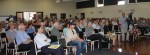
Attendees from across Victoria packed into a conference centre in Oakleigh for Sunday’s Victorian Smart Meter Forum.  Organizers estimated attendance levels at between 400 and 450, with latecomers spilling out onto the foyer.  Representatives from over 12 Victorian Smart Meter Action Groups hosted tables at the rear of the hall and a number of Councillors representing different City Councils were also in attendance.  The forum was also ‘honoured’ by the attendance of Mark Travill, Senior Consultant from Plum Communications and smart meter Community Liaison Manger for the Department of Primary Industries, who was busily writing copious notes during the forum.

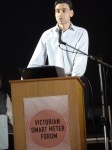
Councillor Helen Patsikatheodoru from Hume City Council ably chaired proceedings.  Opening keynote speaker Dr. Don Maisch of EMFacts Consultancy in Tasmania explained the conflict of interest between the setting of standards and industry interests.  He stated that our standards are essentially “cooking standards, establishing that you won’t get cooked”.  They do not look at non-thermal effects of radio frequencies.   He cited numerous overseas bodies who have called for an urgent revision of standards.  Calls for precaution have been issued by the Freiburg Appeal in 2012 (signed by over 10,000 doctors), American Academy of Environmental Medicine and the Council of Europe Report.   Dr. Maisch pointed to Russian research which shows that in the third stage of exposure (over five years) irreparable damage to biological systems may occur.  He contends that more independent research is urgently required, especially in relation to smart meters and their effect on sleep patterns.

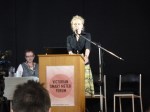
Nicole Bijlsma, author of Healthy Home, Healthy Family, a Building Biologistand founder of the Australian College of Environmental Studies, presented a moving account of the effects of increased electromagnetic radiation levels on the population and, in particular, on children.  She said that our children are the “canaries in the mine”.  Nicole pointed to overseas standards for radio frequency emissions which have been set at a fraction of our standards.  She called for urgent action on smart meters, saying that smart meter emissions affect the population in their home, the one place in which children were able to rest and should be safe.  Nicole said that already 30,000 papers have been produced on electromagnetic radiation in the last 30 years.  “By the time the data is available [on smart meter effects], it may be too late.”

The afternoon’s programme included harrowing accounts by two sufferers of the health effects they had experienced from smart meter emissions. Alan Manson, a representative from the Geelong Smart Meter Action Group gave a brief overview of smart meter privacy issues and Sonja Rutherford of the Broadmeadows Progress Association explained the legal advice which has been obtained from a barrister.  It was clarified that no power company has the power to force anyone to accept these new meters.  Mrs Rutherford also spoke about the economic impact of smart meters with proposed ‘time-of-use’ tariffs.  The forum concluded encouraging people to spread the awareness of the truth about smart meters by telling everyone they know.

Feedback from the forum has been overwhelmingly positive and special thanks go to the speakers and the Glen Eira Smart Meter Action Group for organising and hosting such a professional event.

To quote German Philosopher, Arthur Schopenhauer:

“All truth passes through three stages.  First, it is ridiculed.  Second, it is violently opposed.  Third, it is accepted as being self-evident.”

Thank you to all!

Forum Presentations:

Public meeting presentation

Nicole Bijlsma Presentation

Privacy Presentation and related video

Photos (click for better view):

Forum Video:

http://www.youtube.com/watch?v=6PHhqJBBEms

Posted in Smart Meter | Tagged , , , , , , | 89 Comments

Jemena blames politics for smart meter confusion

One of the largest network operators in Victoria has criticised state  governments in Victoria and New South Wales over their handling of the debate  about the roll-out of smart meters.

Jemena, which provides electricity to 319,000 homes and businesses across  north-west Melbourne, said the Victorian government under Ted Baillieu had  failed to back the $2.3 billion program for political reasons.

An earlier version of the program introduced by Labor premier John Brumby  used simpler devices and would have cost $850 million.

The larger sum, along with Wonthaggi desalination plant and the Myki transit  card, became key election fodder for the Coalition and they have continued to  wield it, Scott Parker, Jemena’s general manager corporate affairs,

The government was happy to attend launches of online portals by firms such  as Jemena that show how households could save money from the meters, he  said.

“But it won’t get up there and defend the integrity of the program, and will  still call it a program whose budget blew out under the previous government – and no such thing happened – but it’s not in their political interest to say  otherwise.”

Victoria’s Energy and Resource Minister Michael O’Brien, though, said the  state’s Auditor-General had found a “massive smart meter cost blowout” during  the former government’s watch.

“The Coalition Government independently  reviewed the program,” Mr O’Brien said in a statement. “As a result we are  reining-in the costs and bringing forward the benefits of smart meters to  consumers.”

The Baillieu government decided a year ago to proceed with the mandatory  state-wide introduction of the intelligent metering device – which provides  two-way communication between the consumer and the energy provider – but had  provided textbook “learnings” that other states would do well to study, Mr  Parker said.

“The big thing was that smart meters needed to be rolled out in conjunction  with time-of-use pricing … so that people can see the benefit.”

Instead, the government introduced a moratorium on more flexible pricing in  the state six months after the first meter installed, leaving consumers confused  and opposed to the meters. From next July, Victorians will have the option to  choose variable pricing from peak to shoulder and off-peak rates.

“The Coalition Government is determined to make smart meters start to pay  their way, after years of mismanagement by Labor,” Mr O’Brien said.

“Victoria will be the first State to introduce widespread access to flexible  pricing and off-peak rates from mid-2013”.

NSW view

Mr Parker said comments reported  today in Fairfax Media that NSW’s Energy Minister Chris Hartcher was  considering introducing smart meters on a voluntary basis foreshadowed far  higher costs for the state than a mandatory roll-out.

“If you think there are significant cost pressures on the system now, and  you’re going to run two metering systems, you’ve seen nothing ,” Mr Parker  said.

Singapore-owned Jemena is also critical of the Victoria government’s mixed  signalling on whether the new meters would be mandatory or not. In May last  year, Premier Baillieu said on radio that people could defer installation of the  meters, comments that have been repeated time and again.

“That played all sorts of havoc,” Mr Parker said, adding that the government  doesn’t understand how much disruption the comments had caused the whole  industry.

As a result, Jemena still has about 170,000 homes and businesses to connect  by the end of next year, with financial penalties if the target isn’t met.

“It’s going to be a real challenge” meeting the goal, Mr Parker said, adding  that the company was yet to formally seek an extension.

Jemena supports policy

Jemena later issued a media statement distancing the company from Mr Parker’s  comments.

“Jemena  in no way endorses any of the comments reported in the article and   confirms that it remains completely supportive of the smart meter  program and  the Baillieu Government’s role in leading the program,”  Managing Director Paul  Adams said in the statement.

“Jemena  has consistently and publicly supported the program for over three  years  and has promoted its benefits to customers publicly on numerous   occasions in recent months,” Mr Adams said.

Via: http://www.theage.com.au/business/jemena-blames-politics-for-smart-meter-confusion-20121127-2a5dr.html#ixzz2Dg2EzLqu

Posted in Smart Meter | Tagged , , | 7 Comments

Darebin Smart Meter Awareness Meeting – 4 December

Posted in Smart Meter | Tagged , | 5 Comments

NSW urged to market smart power meters | The Australian

A NSW discussion paper has recommended the state introduce a “market-led” rollout of electricity smart meters, saying it would be costly to taxpayers and consumers if the system was mandated by government.

NSW Energy Minister Chris Hartcher on Tuesday released the discussion paper from the Smart Meter Task Force, which warned against a Victorian-styled government rollout.

The controversial Victorian scheme was initially expected to cost $800 million, but the latest estimates have seen that blow out to more than $2.3 billion.

In Victoria the smart meters have also been linked with unpopular time-of-use pricing, which charges consumers more for usage in peak periods.

The NSW government task force said a mandated introduction of the meters would “almost certainly” lead to higher consumer prices, while the state would also be saddled with the cost of the rollout.

On the other hand, it said a voluntary “market-led” approach would lead to lower take-up costs, and would encourage energy companies to develop innovative products for consumers.

Mr Hartcher said NSW was against any mandated rollout of smart meters, which typically record usage information half-hourly, giving consumers a more detailed picture of their energy consumption.

The meters also transmit that information to power companies on a daily basis.

“The NSW Government has learnt from the Victorian experience and does not advocate a mandated approach as pursued by the Victorian Government, but believes a market-based approach may have a role to play,” Mr Hartcher said in a statement.

“Energy businesses should have flexibility to offer innovative products that customers want, not ones that a government has forced upon them.

“Not all households will benefit equally from smart meters – different households will have different consumption patterns – and the NSW Government is keen to ensure that low income households and vulnerable customers are not impacted adversely by any potential introduction of smart meters.”

Public submissions on the discussion paper will close on February 28, Mr Hartcher said.

via NSW urged to market smart power meters | The Australian.

——————————————————————————————————————-

Time to move to NSW!

Posted in Smart Meter | Tagged , , , , , , , | 11 Comments

Smart move, but not for consumers – The Age

DO WE really want to check our smart meters every time we turn on the dishwasher, take a shower or toast a slice of bread?

Has anybody wondered why almost every power company and lobby group in the country is pushing for the introduction of smart meters? It is worth pondering, for government, it seems, is about to fail the public again over energy policy.

First it was a faulty regulatory system which gave rise to ”gold-plating”, or overspending on networks, and spiralling power bills. The increase in ”peak demand” remains the industry catch cry to rationalise its rampant spending, even though peak demand has actually been falling for three years.

But as the myth of peak demand is now harder to propagate, industry is pushing for smart meters. The smart meter is the next big ruse.

Smart meters and ”flexible pricing” merely shift the business risk from the company to the consumer. Like mobile phone bills, their sheer complexity will enable the promoter to game the customer.

Who will pay for the devices? Who will pay for the software upgrades? Where should the metering company sit, in an offshore structure? Should the device be company-specific?

The power lobby has done a first-rate job of spruiking the

smart meter regime to governments so far, despite the issues in Victoria, the only state where they have been installed.

”In my view, smart meters combined with flexible tariffs are the next ‘gold-plating’,” says Bruce Robertson, the industry critic from consumer activist group Manning Alliance who exposed the ruse of overspending.

”The generators already game the NEM (National Electricity Market) by withholding supply at peak times and so on. Smart meters combined with time-of-use pricing open up a whole new range of gaming possibilities.”

The consumer takes on all the business risk for a start, says Robertson. If a power station, for example, suffers an outage for whatever reason, consumers pick up the cost.

Wholesale electricity prices can be extraordinarily volatile (they can be as high as $12,500 per megawatt; although, perversely, the price per megawatt-hour can also be negative). Under a flexible pricing regime the customer pays for this, says Robertson.

”Just how much fun is it to get the family together to eat a turkey at Christmas only to find it will cost $50 to roast it because some technician at a power station dropped a spanner in the works?”

This story really only deals with the economic and market aspects of the smart meter. There is a human cost. In lifestyle terms, the implications of constantly checking, or worrying about not checking a meter, will affect a lot of people.

Who wants this hassle, when a simple peak and non-peak regime could be introduced? The customer would simply know that taking a shower at peak periods costs more.

Smart meters don’t come cheaply, as Victorians have discovered. Originally slated to cost $800 million, the state rollout is now shaping up at a cost of $2.3 billion.

Instead of seeing how things turn out in Victoria, however – and there have been a host of other concerns raised, from safety issues to privacy – the government seems intent on rushing headlong to push them into every part of the country.

A leaked letter to the Prime Minister from Martin Ferguson’s standing committee of energy and resources last week eulogised the smart meter as the solution to high energy prices.

”A confidential draft of a blueprint for Julia Gillard to take to next month’s Council of Australian Governments meeting reveals the Commonwealth is proposing to encourage a rollout of smart meters and other advanced systems so that consumers could sign up to packages with ‘time-of-use’ tariffs,” said a newspaper report.

There is little evidence yet that smart meters lead to lower energy bills. While we don’t know if they work, we do know that they are expensive – and that expense is borne by the consumer.

As IPART (Independent Pricing and Regulatory Tribunal) says in its submission to the Senate inquiry, the logical thing to do, before rolling them out to the entire market, is to wait and see the results in Victoria. The rollout is scheduled to finish in 2013 and flexible tariffs will be introduced. What is needed is a cost/benefit analysis. What is the rush?

”The rollout of time-of-use meters should be at the discretion of the customer or their retailer rather than being mandated by governments or distributors,” says the submission. It is worth noting that, when it comes to the furore over electricity prices, IPART has consistently been on the right side of the debate.

For industry, smart meters promise enormous returns – and not just via tricky pricing opportunities and the transfer of risk to the customer.

Read the rest via Smart move, but not for consumers.


Posted in Smart Meter | Tagged , , , , , , , | 12 Comments

Victorian Smart Meter Forum TODAY

Please note, according to some Melway maps, Willesdon Road is in Hughesdale.

Posted in Smart Meter | 14 Comments

How safe are Smart Meters?

Victorian campaign warns of radiation health risks. Pressure grows on Baillieu government to follow UK and US models for voluntary take-up.

‘Smart’ electricity meters being installed across Victoria are a serious health risk and should be a matter of choice, according to Stop Smart Meters Australia – a campaign to make Victorians aware of alleged shortcomings and side-effects of the new technology. Smart Meters, which automatically measure electricity consumption and broadcast the data wirelessly via radio frequencies, began rolling out in 2009 as part of the government’s plans to upgrade the state’s electricity infrastructure.

Unless the Victorian government amends these plans, all households and small businesses will have their existing meter replaced with a Smart Meter by the end of 2013. But while the government’s Department of Primary Industries remains upbeat about the roll-out of the system – a vocal and growing lobby asserts that the serious health risks posed by Smart Meters have not been adequately researched by the government.

Already a number of people who have had Smart Meters installed claim to be suffering serious symptoms of illness due to the devices. Peggy (75), from a well-known Greek family in Seaford, told Neos Kosmos that after her Smart Meter appeared the first symptom was insomnia followed by ringing sounds in her head. “I couldn’t sleep and I’d never had a sleeping problem before in my life.

“I was extremely hot, I was burning. I had different noises in my brain, one side it was like bells ringing and I had nausea and headaches,” says Peggy Her Smart Meter was installed in early February 2011 and within a month she had begun to feel unwell.

“My blood pressure was high. I finished up in the the Afred Hospital’s emergency department. I had a lot of different symptoms and they all started after the Smart Meter was installed,” says Peggy. Now undertaking holistic and homeopathic treatments to alleviate her symptoms, she says she’s had to move her bedroom away from the meter, but her problems remain ongoing.

“The energy’s too high, it’s cooking me,” she says. “If they want to kill me, kill me with a gun not this slow torture.” Peggy and her family say the climbing plant on the exterior wall alongside the Smart Meter also began to wither as her symptoms became apparent, another victim of the device. Today the plant’s leaves are a pale, anaemic shadow of their former glory.

The family have written to the Victorian government asking for her Smart Meter to be removed, but without a shift in the government’s policy for implementing the original legislation – Victoria’s Electricity Distribution Code – she has little hope of the meter disappearing. On November 25 in Oakleigh, the Victorian Smart Meter Forum will share the latest scientific research on the impact of electromagnetic radiation and wireless systems – as used by Smart Meters – on consumers’ and the environment’s health.

Joanne Chak, one of the forum’s organisers told Neos Kosmos. “The Victorian Government claims Smart Meters are safe however their final report sidestepped the health effect issues altogether. “There is mounting strong scientific evidence that smart meters are not safe. “Our concern is that Victorians have not been given the opportunity to discuss or even choose whether they would like one of these meters fitted in their homes or their community.”

Chak points out that In February 2012 Smart Meters became voluntary rather than mandatory in the US and UK. Alex Alexis – spokesman for the City of Whittlesea Smart Meter Awareness Group and an IT engineer by trade – told Neos Kosmos that Victoria has been desginated as the guinea-pig in what he believes is a potentially dangerous experiment.

“Victoria’s the only state at the moment that has a mandate to roll Smart Meters out. “It’s a case of ‘experiment with Victoria first, let’s see how the public reacts and then we’ll worry about the rest of the country later'”. Highly critical of what he sees as a lack of proper research by the Victorian Government into the potential effects of Smart Meters on people’s health, Alexis says that international evidence exists to back up fears over Smart Meters, in particular a press release issued by the World Health Organisation (WHO) in May last year.

The press release – issued jointly by the WHO and AIRC (the International Agency for Research on Cancer) classified radio-frequency electromagnetic fields similar to those used by Smart Meters as “possibly carcinogenic to humans (Group 2B), based upon an increased risk of glioma – a malignant type of brain cancer”. “This is evidence on a world scale, given by one of the world’s biggest scientific bodies,” says Alexis, whose Whittlesea group have approached their local council to take up the matter with the state government.

“We’ve asked them to write to the Premier for clarification, and ask if residents can have a choice on Smart Meter installations. “They’ve taken away our civil liberties. For Baillieu to say Smart Meters are mandatory is a breach of human rights. It should be a choice,” says Alexis. This week Neos Kosmos contacted the office of Energy and Resources Minister Michael O’Brien, to ask if the terms of the Smart Meter roll-out could be changed to allow consumers to exercise choice in the use of the technology.

The minister’s statement doesn’t suggest Victoria’s mandatory experience of Smart Meters will be transformed anytime soon. “Under an order in council by the former Labor Government in 2007, Smart Meters are required to be installed in all Victorian households and businesses by the end of 2013,” said the minister.

He went on to add that the Coalition Government’s continuation of the roll-out was being undertaken “following an independent review” and after “significant reforms to the program.” The minister’s statement ended by confirming that “under Victoria’s Electricity Distribution Code, property owners who want to be connected to the grid are legally required to allow their distribution business access to the company’s meter to undertake the upgrade.”

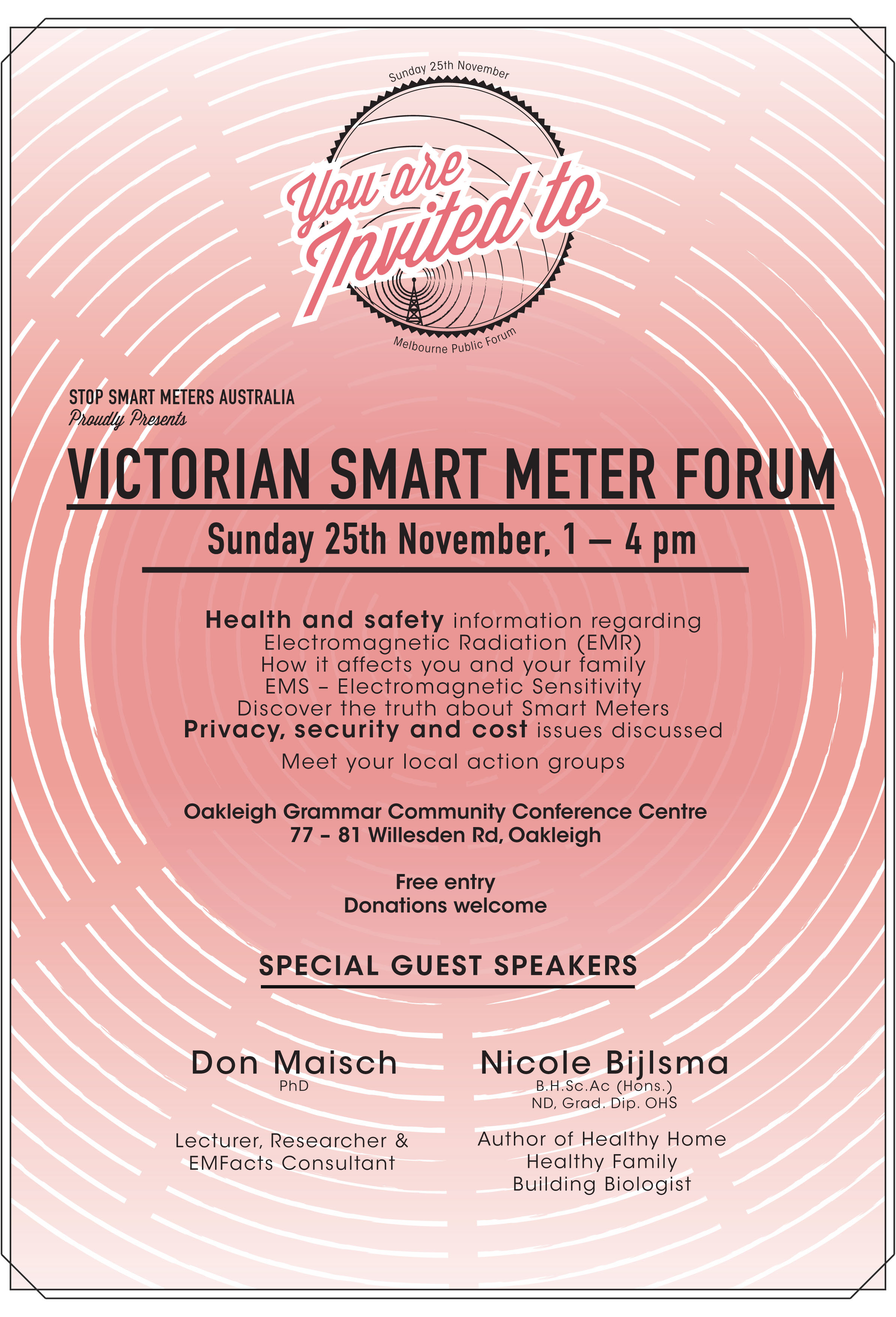
Victorian Smart Meter Forum – November 25 To hear the views of those campaigning to stop the compulsory installation of Smart Meters, as well as experts who have studied the physiological effects of electromagnetic fields, the Victorian Smart Meter Forum will take place on Sunday 25 November (1pm-4pm) at Oakleigh Grammar Community Conference Centre. Guest speakers will include lecturer and EMFacts consultant Don Maisch PhD and Nicole Bijlsma, author of Healthy Home Healthy Family. Admission is free and the forum will start at 1pm.

MICHAEL SWEET, Neoskosmos, 20 Nov 2012

Posted in Smart Meter | Tagged , , , | 9 Comments

Groups rally against meters – Bendigo Advertiser, Nov. 21, 2012

Posted in Smart Meter | Tagged , | 8 Comments

Smart meters locked out in Darebin – Health – News – Preston Leader

MEMBERS of Darebin’s Progress Association are encouraging residents to padlock their electricity boxes to stop smart meters being installed.

Association spokeswoman Marion Harper said Melbourne barrister Eugene White had given legal advice there was nothing illegal in refusing smart meter installation.

But power company spokesman Scott Parker said residents who locked meter boxes and refused smart meters risked having their power cut off.

Ms Harper, a Reservoir resident, said she and others who’d padlocked their meter boxes were worried about radiation from the smart meters.

“When I’m in bed, my head is near where the electricity box is,” Ms Harper said.

“They’re saying it’s safe now but this could be the next asbestos or cigarettes.”

She said there were also privacy issues and concerns it could further push up electricity bills, or force people to do their washing at 3am to avoid peak times.

“A lot of us feel very strongly about these issues,” Ms Harper said.

“When they came to install smart meters at a Greek retirement village, three women chased them down with brooms.”

Read more via HAVE YOUR SAY: Smart meters locked out in Darebin – Health – News – Preston Leader.

Posted in Smart Meter | Tagged , , , , , , , | 12 Comments