Community Response to ARPANSA’s statement on the ABC Catalyst program entitled “Wi-Fried?”

It has become quite obvious by follow up stories in the media that pressure from certain quarters is being applied in order to have the recent TV program “Wi-Fried?” retracted and the journalist who developed it censured. This behaviour is tantamount to bullying and also appears to be an orchestrated attempt by vested interests to stifle scientific debate on an issue that has a potential impact on us all.

Many of our members were also particularly upset with the response from the Australian Radiation Protection and Nuclear Safety Agency (ARPANSA) to the program.  This has led to SSMA writing a formal letter of complaint to ARPANSA on behalf of the community.

One of the main concerns is that ARPANSA’s statement contains claims which are likely to mislead the public and creates an impression that does not accurately reflect scientific opinion.

The claim that “It is the assessment of ARPANSA and other national and international health authorities, including the World Health Organization (WHO), that there is no established scientific evidence that the use of mobile phones or Wi-Fi devices cause any health effects” fosters the impression that there is unanimous agreement on this point.
This simply is not true; there are other radiation protection and health authorities which consider that mobile phones and Wi-Fi do cause health effects. This diversity of opinion has not been acknowledged in ARPANSA’s statement…..

….Our members are also concerned that ARPANSA’s statement trivialises adoption of precautionary approaches by implying that this advice is only relevant to “people who are concerned”. ARPANSA’s tips, although providing a solid starting point, also fall short of the recommendations provided by some other authorities…..

The complete letter to ARPANSA can be downloaded from here Community Response to ARPANSA 22 February 2016.
Posted in Smart Meter | Tagged , , , , , | 22 Comments

Sometimes Asking Questions Provides You With Answers That May Be Uncomfortable

Maryanne Demasi, via Huffington Post

The claims that our program “should never have aired” should not sit well with the public. At best, it’s an over-reaction. At worst, it’s a form of censorship.

Sometimes in science asking questions provides you with answers that may be unsettling. Not because they are conclusive, but because they are inconclusive. It’s the duty of scientists and science reporters to encourage critical thinking on issues that are still up for debate.

Several other counties around the world have more stringent radio frequency safety thresholds than Australia. Italy, China, Switzerland and Russia have wireless safety limits, which are a hundred times more stringent than our own. In France, they restrict advertising of mobile phones to children. They have also banned Wi-Fi in nurseries and day care centres.

So I decided to investigate. Why are some countries making these changes and not Australia? To say that this is a fringe view is not sustainable.

Wireless technology is relatively new and the science in this area is not as settled as is often claimed. Especially in relation to children. That is why a study is currently underway, involving over 14 countries, which is assessing whether the use of mobile phones at an early age increases the rates of early onset brain tumours in 1000 young people. The results will be released this year……

As an investigative journalist, I am used to taking some heat from critics. It’s part of the job. Catalyst is no stranger to controversy. As investigators, we have studied emerging scientific debates at home and abroad, and brought them into Australian living rooms. What was perceived as controversial a few years ago, like discussions on dietary sugar or the over-prescription of cholesterol-lowering medications called statins, is now widely debated overseas by mainstream media outlets…..

The great thing about science is that new discoveries are constantly made and orthodoxies change. Sometimes so-called “fringe” views move into the mainstream, forcing governments to change policies to prevent public harm. This has happened many times. Think back to thalidomide, asbestos, tobacco. We are not suggesting this will necessarily happen in the case of wireless technology, but it’s also not scientific to claim the door has been slammed shut on this discussion….

See full article at: Huffington Post 

Posted in Smart Meter | Tagged , , | 7 Comments

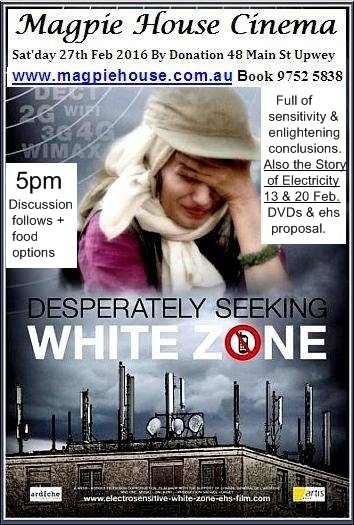
Screening of ‘Desperately Seeking White Zone’, 27 February, Upwey, Victoria

Cinema2016WhiteZoneP

Posted in Smart Meter | Tagged , | Leave a comment

Wi-Fried? 30 Minute ABC Documentary – A must see!

If you missed ABC’s Wi-Fried, here it is:

http://iview.abc.net.au/programs/catalyst/SC1502H003S00

Watch Dr Devra Davis and the former CEO of Microsoft Canada, Frank Clegg, talk about the health risks of mobile phones and wi-fi – and ARPANSA (Australian Radiation Protection and Nuclear Safety Agency) defend the indefensible.

If you liked the program, you can show your support and make a comment at:

a. Catalyst website at: http://www.abc.net.au/catalyst/stories/4407325.htm
b. Catalyst Facebook page at: https://www.facebook.com/ABCCatalyst/
c. http://www.abc.net.au/contact/contactabc.htm


Posted in Smart Meter | Tagged , | 7 Comments

Victorians shun ‘flexible’ electricty price plans spruiked as smart meter benefit

VICTORIANS have shunned “flexible” electricity price plans that were spruiked as a smart meter benefit.

Just 8100 customers — fewer than 1 per cent — have adopted the deals that were introduced more than two years ago, latest figures reveal.

Retailers had said the voluntary time-of-use tariffs could save some households $150 a year.

Customers are rewarded for using power late at night, early in the morning and on weekends, and pay a premium at weekday peak times.

Vinnies energy expert Gavin Dufty said households had a right to feel disappointed with smart meters, with most yet to see a “tangible benefit” from the $2.2 billion rollout.

“All we see is ever increasing complicated pay-on-time discounts, with very few companies offering pricing and services that give customers more control of their bills,” Mr Dufty said.

Energy Minister Lily D’Ambrosio said: “Victorians can maximise the benefits of solar panels and other energy technologies via their smart meters, connections are cheaper, and faults are detected more quickly”.

The dismal flexible tariff take-up comes as the Government defends letting customers “opt in” rather than “opt out” of planned “cost reflective” electricity distribution demand charges phased in from next year.

“We are giving Victorian households, not electricity companies, the choice about what pricing arrangements are right for them,” Ms D’Ambrosio said.

Victorian distributors responding to an Australian Energy Market Commission rule have proposed monthly demand tariffs based on maximum half-hour use during 3pm-9pm weekdays, with highest rates in summer.

Such pricing aims to encourage appliance use outside peak demand, and make those draining the network most pay their “fair share”.

It is designed to reduce investment needed for grid upgrades, therefore lowering bills on average.

But Ms D’Ambrosio said many families would be worse off if forced onto changes.

Grattan Institute energy program director Tony Wood has described the Government’s stance as a “setback for electricity tariff reform”.

But Consumer Action Law Centre chief Gerard Brody said: “Let’s hope the opt-in model provides the incentive to our energy suppliers to better communicate the benefits of tariff changes to the community”.

Karen Collier, via Herald Sun

Posted in Smart Meter | Tagged , | 25 Comments

“Wi-Fried?” documentary – Catalyst, 16 February, 8:00 pm

Wi-Fried?

You can not see it or hear it but Wi-Fi blankets our homes, our schools and our cities. Many of the mobile devices we carry close to our bodies like smart phones, laptops, tablets, even watches are connected to Wi-Fi.

A growing number of scientists are concerned that the widespread use of wi-fi and wi-fi enabled devices could be slowly making us sick. In this Catalyst investigation, Dr Maryanne Demasi takes a closer look at the link between mobile phones and brain cancer and explores whether our wireless devices could be putting our health at risk.

This not-to-be-missed  documentary also features Dr Devra Davis and the former CEO of Microsoft Canada.

Catalyst (ABC Australia) – 16 February, 8:00 pm (Australian Daylight Saving Time)

See Promo

Posted in Smart Meter | Tagged , , , | 8 Comments

AGL releases plans for smart meter installation in NSW and South Australia

Victoria was the trial state [in Australia], Tasmania made it optional but didn’t confirm health was at risk with a smart meter installation. Now South Australia and New South Wales seem to be the next states to push smart meters.

Despite the fact that AGL decided to hide the term ‘smart meters’ in their FAQ page, it is clearly spelled out on their website: Smart meters are coming to SA and NSW! Billing accuracy and monitoring are being sold to their customers as benefits. There have been many stories about raised bills with smart meters and very few of them actually lowering bills, so be careful there.

It seems the term ‘Smart Meter’, which now has much negativity associated with it, is being avoided as much as possible to not alarm customers. The term ‘Digital Meter’ is used instead.

The AGL site shows that customers have an ability to opt out if they notify the company first. They may send a letter announcing the installation, but if one fails to go through the proper process for the ‘opt out’, it is likely a smart meter will be installed, no matter if you are home or not.

Via: http://en.geovital.com/au-news-agl-released-plans-for-smart-meter-installation-in-south-australia-and-nsw-homes/

Posted in Smart Meter | Tagged , , | 32 Comments

Have your say about smart meters – Standards Australia Sydney Forum

Standards Australia will be facilitating a Roadmap for Advanced Metering throughout
2016. The work is designed to support the safe and efficient roll out of smart meters
in Australian cities and communities as the country progressively transitions to a
smarter economy.

The Roadmap will consider a number of important metering issues including safety,
tariffs and load control, testing, Australian community expectations, temperature ranges and other relevant issues.

All relevant stakeholder groups are welcome to participate in the Roadmap. Participants
will have the opportunity to join the discussion after the presentations.

Views expressed during the discussion will assist in the shaping of future standards
development work in this important technology area.

The forum will be held on Thursday 3 March, 2016 at Level 10, 20 Bridge St, Sydney, 10:00 am – 2:00 pm.  Light lunch will be provided.

This is a complimentary forum and places are limited. To confirm your attendance, please
RSVP by Friday 19 February to nsm@standards.org.au.

For further information and a copy of the forum invitation click E-1095 Advanced Metering invite  or visit Roadmap for Smart Meters.

If you live in Sydney or NSW, please attend this forum and have your say about smart meters and the need to retain analogue and non-smart meter digital meters as part of Australian Standards for metering. 

Posted in Smart Meter | 19 Comments

Over 100,000 smart meters to be removed!

Last week in Ontario Hydro One admitted that rural smart meters do not work, and decided to pull the plug on 36,000 of them to start with.

In addition, another Canadian company, BC Hydro, announced plans to remove 88,000 smart meters suspected of failure.

This is great news for our movement…

Read the full story by Josh de Sol at: http://www.collective-evolution.com/2016/01/20/ontario-pulls-plug-on-36000-rural-smart-meters-is-big-energy-imploding

Posted in Smart Meter | Tagged | 15 Comments

Cyprus Government Campaigns to Protect Children from Wireless Technology

The Cyprus Government’s National Committee on Environment and Children’s Health launches a public campaign to protect children from the harmful effects of wireless technology.

When will the Australian Government wake up and follow suit?  Or isn’t the health of our children a priority?


Posted in Smart Meter | Tagged , , , | 17 Comments