
Part 4 of my Blog – Taking a Stand
As I mentioned in my previous blog “Taking a Stand Part 3”, ARPANSA eventually responded to my questions but unfortunately some of my questions were not directly answered, ARPANSA either provided an answer that skirted around the issue or in one case, simply removed the point from their response sheet as if it had never existed – perhaps a copy and paste error? I have updated the original question sheet I sent with ARPANSA’s responses and my commentary, which can be found here -> ARPANSA Questions with commentary
The original document returned from ARPANSA is attached here -> ARPANSA Questions response included a covering letter. I have decided to quote some key statements made by ARPANSA’s CEO that deserve additional attention in this blog.
“The classification by IARC corresponds to the current ARPANSA advice, including its advice on practical ways in which people can reduce their exposure to the electromagnetic fields produced by wireless telephones.” This is all very nice but what about smart meters? I see no practical advice from ARPANSA on how I can reduce my exposure to smart meter emissions. Avoid usage of my front rooms and bedrooms to reduce my exposure or pay thousands of dollars out of my own pocket to shield those rooms in order to be able to use them again? Why should I be made to suffer so that the Power Utilities can save some money by remotely reading my meter without needing to employ meter readers?
The WHO does not have a specific position on smart meters, just on RF in general, therefore when ARPANSA says that they are “not aware of any change of position by the WHO in regard to the likelihood of health risks from the low exposures produced by smart meters” it is at best nonsensical and at worst an attempt to mislead.
“The classification by IARC corresponds to the current ARPANSA advice….” Yet here in Victoria, the power utilities, in full knowledge of IARC’s classification of RF as a Group 2B carcinogen, are blanketing the state with unnecessary RF. Where a “precautionary principle” could have been implemented but in practice it is not being followed. I will have more on the role of the Australian Communications and Media Authority and the application of a precautionary principle in my next blog.
“The WHO is currently undertaking a comprehensive assessment of the potential health impact of RF EMR exposures and this will take into account the IARC decision”. If this is true then wouldn’t it have been sensible to not roll out wireless transmitters in every home until this assessment is complete? Even if ARPANSA passes on this responsibility to ACMA because they regulate the standards, ARPANSA has assumed responsibility because they have allowed government bodies such as the DPI to promote and justify wireless smart meters to the general public using ARPANSA’s RF standards to say they are safe.
The statement: “ARPANSA maintains continual oversight of emerging research into the potential health effects of the RF emissions from smart meters…” is incorrect because to maintain continual oversight would entail commissioning a post rollout surveillance study that looks for possible health effects – no such study exists. To date all my requests to have my health issues investigated have fallen on deaf ears. (Many others are experiencing the same issue too!)
All in all I was quite disappointed in the response that I received from ARPANSA but it was to be expected. It is also very disconcerting that simple mistakes have been made by so called experts in responding to my questions which gives me no confidence in an organization that has been entrusted to protect our health from unnecessary exposure to all forms of radiation.
Apparently an Expert Panel is tasked to investigate the latest research to validate our standards, yet we have no idea what studies are being looked at and why it appears studies that show potential health effects below the thermal threshold are not worthy of consideration. There is a complete lack of transparency in the whole review process. Let us hope that ARPANSA considers what I have written here but I won’t hold my breath.
I would like to conclude with the following important pieces of information.
Dr Paolo Vecchia who was Chairman for ICNIRP (2004 – 2012) had presented at the Radiation Research Trust conference in September, 2008. In his presentation, he made it very clear that, “the ICNIRP guidelines are neither mandatory prescriptions for safety, the ‘last word’ on the issue nor are they defensive walls for Industry or others.” <– please substitute “others” with “ARPANSA”
Exposure misclassification biases toward the null hypothesis
“A Swiss personal monitoring study found that mobile phone use currently accounts for one-third of total exposures to wireless and microwave radiation, with routers and base stations accounting for the rest.
Current standards rest on the assumption that permitted levels of microwave radiation from mobile phones do not induce any measureable change in temperature or biological effect. Several independent avenues of research have shown this assumption to be incorrect.
Misclassification of exposure is well known to bias toward the null hypothesis, or to a finding of “no effect” when, in fact, an effect may well be present. None of the studies carried out on cell phones thus far, including those of Hardell, has taken into account these important other exposures, many of which have changed quite recently and continue to rapidly expand.”


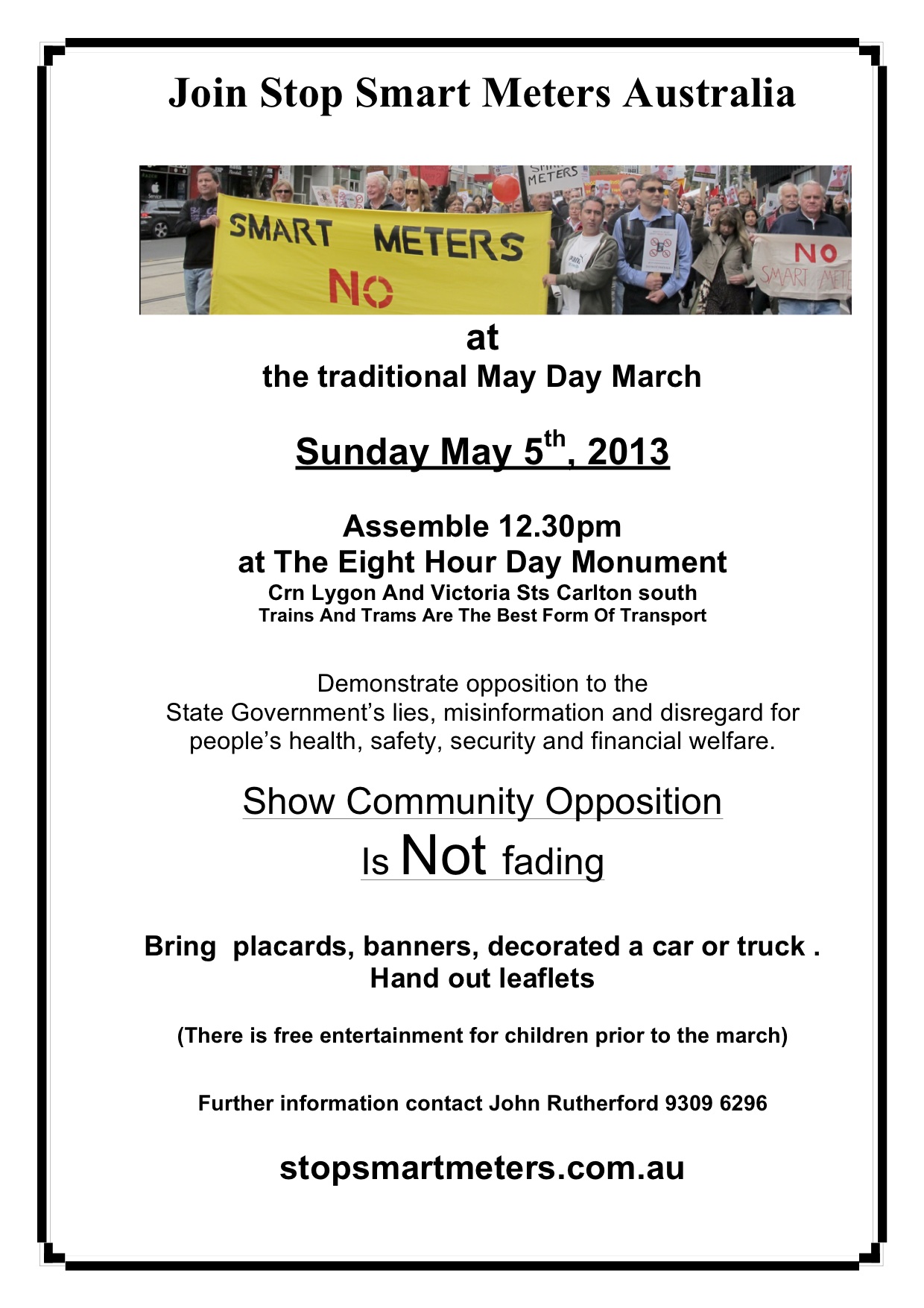


 Stop Smart Meters Australia