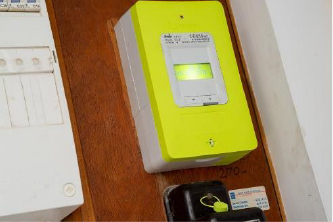
Worldwide testimonies about smart meters

Arthur Firstenberg, author of The Invisible Rainbow: A History of Electricity and Life and administrator of International Appeal to Stop 5G on Earth and in Space, recently asked people to email the USA’s New Mexico Public Regulation Commission (PRC) about their experiences with smart meters.  

‘Heartbreaking testimonies poured in from around the world. Stories about catastrophic effects on the health and lives of adults, children, the elderly, pets, farm animals, birds, wild animals, insects, worms, plants, neighbours, workers and entire communities.

Below are excerpts and summaries of some of the 271 testimonies that are posted on the public comments page of the PRC’s website…

Jennifer Andree is a New Mexico resident who was severely injured by a smart meter “that has completely devastated my life.” She is a nurse and a veteran who knew nothing about smart meters until she was injured by one. This occurred on Kirtland Air Force Base in New Mexico. “For three and one-half months,” she writes, she slept with her head approximately one foot away on the other side of a wall from an electrical panel containing two electric smart meters. “Anything that carries an electric current or emits any radiation” now causes her headaches, brain fog, and internal burning. “I can no longer tolerate living in an urban environment,” she writes, “so I have moved to South Dakota, to a cleaner environment in the country. Because of the harms I was exposed to, I am separated from my family, which has contributed to my suffering… I have a nursing license, but can no longer work in my profession.”

Maryann McCabe writes from the UK: “From the time [the smart meter] was turned on, I could not walk around in my flat, I could not write an email, I could not think and I could not sleep. It was an absolute nightmare until it was switched off.”

Harriet Greene, formerly of New Mexico, writes: “I was able to opt out and keep my old meter. Everybody I talk to who was forced to accept smart meters has complained of numerous effects.”

Lauren Bond writes, “Smart meters were installed in my building, and the radiation they emit inside apartments creates for myself, a constant burning pain to my skin.”

Jeanne Thompson writes from California: “My mother died of a massive brain tumor caused by a row of six Smart Meters outside her condo, on the wall where the head of her bed was. We discovered this after she had already passed. You can imagine my shock and horror at that realization.”

Dr. Linda Thomas writes, “I have seen hideous debility in adults and children secondary to Smart Meters being installed in my area.” These include absence seizures in a 2-year-old boy and chronic fatigue and fibromyalgia in his mother.

Mario Desira writes from Malta: “Back in 2017 my electrical meter caught fire and nearly caused a house fire. Luckily I was at home and intervened before anything worse happened.”

Persephone Maywald writes from California that she was diagnosed with suspected Parkinson’s disease a few months after a smart meter was installed, and that she later had the meter replaced and within a few weeks all her symptoms disappeared.

Simone St. Clare writes from California that since a smart meter was installed, there have been almost no hummingbirds at her feeders and a decrease in caterpillars in her garden.

Deirdre Novella writes from New York that her hair started falling out within a few months of a smart meter being installed at her place of work, that she was diagnosed with leukemia, and that she developed a lifelong allergy to electricity.

Sheila Reavill, who works as an electromagnetic radiation specialist (“EMRS”) in Georgia, writes that after smart meters were installed, “the smart meter signature I logged [on her radio frequency meter] in my bedroom was at the precise times I wake up at night”; that her next door neighbor and her neighbor’s daughter wake at the exact same time she does every night; that her border collie began having skin problems and would wake up whimpering at the exact same time also; and that she and her dog both wake up at that same time with diarrhea.

Rebeca Randle writes from California that while she had a smart meter she could not sleep and there were no birds; and that when the smart meter was removed, the birds came back.

Robert Workman, an EMRS in Missouri, writes: “I have confirmed injuries from wireless radiation and the Smart meter seems to be the most damaging to me and my clients. Once the ITRON electronic meter is removed many of my clients have an immediate response to an improved health. This meter has been torture to myself and others in St Louis, it is my professional opinion this meter kills all biological life.”

Health practitioner Diane Peterson writes from California that “For the majority [of people], they suddenly developed symptoms and only later discovered that the symptoms began immediately after the smart meter was installed.”

Sema Kelly writes: “My friend’s neighbor had a smart meter put in. She didn’t know it had such dangers, but soon found out her chickens in the yard had huge tumors growing on their throats and body. The eggs they laid were odd shapes and colors, and the chickens appeared to be tired, which was not ever seen prior to the installments of the smart meters.”

Andre Fayolle writes that a smart meter gave his family headaches, caused the animals, birds and insects to disappear, and caused a fire that burned down his house.

Karen Crenshaw writes from California that she had no knowledge of the dangers of smart meters until an Itron smart meter was installed on her house, after which she awoke abruptly every hour during the night, had uncomfortable ear sensations, acquired high-pitched tinnitus, and felt pressure in her chest.

Annette Lillig writes from the UK: “Everyone I know who [has a smart meter] has been negatively affected by them.”

Beverly Jennings writes: “In Capitola, CA an entire bank of smart meters burst into flames and started a fire and burned down an apartment complex.”

Margaretha Tierney writes from Australia that she became sick two weeks after a smart meter was installed and was sick for five years until she had it moved off her house.

Sarah Wild writes that she had heart palpitations, headache, and panic until her smart meter was removed. She writes that her 80-year-old neighbor “went from being extremely lively, active, outward-going to hobbling around and forgetful within 6 months” of a smart meter being installed and died within 18 months.

Dino DeBenetti writes from Ontario, Canada that after a smart meter was installed, his wife’s health and behavior deteriorated, resulting in their divorce. He also writes that he has attempted to hatch fertile chicken eggs in an incubator in his house twice since the meter was installed, with over 20 fertile eggs each time, and not one egg hatched either time.

Karen Blomquist writes from California that when smart meters were installed on her home she incurred inner ear damage, sleeplessness, anxiety, non-stop heart palpitations, and migraines, and fled her home after two months to save her life. She also reports that her pets all got cancer and passed away.

Tina Cada writes from Florida that although she opted out of a smart meter on her own home, “[o]n the day they were getting installed [in her neighborhood], I walked outside and had no idea where I was. I had the worst kind of disorientation. This reaction was ongoing and lasted for the first few months.” She reports vertigo attacks that have continued, and constant dry mouth, that her teenage son has dry mouth, headaches and sleep disruptions, that her neighbor’s dog suddenly got cancer and died after the smart meters were installed, that her cat started acting differently, and that all the bats disappeared.

Laurie Grams writes from Texas that she lives in an apartment complex and so could not opt out, and has had sleep problems and agitation since smart meters were installed.

Jennifer Wood writes from West Virginia that “I have literally known thousands of people over the past nine years or so who became so ill when smart meters were installed in their homes that they had to move just as I did.”

Elizabeth Foley Walsh writes from North Carolina that she knew nothing about smart meters until after one was installed in her home and she began having severe headaches, dizziness, and temporal lobe seizures the following week. She writes that she thought she was dying until she went camping one week and the symptoms disappeared; that her next door neighbor’s headaches began the same time hers did; that an elderly neighbor across the street began falling repeatedly immediately after their headaches began; and that when she finally moved to a location without a smart meter she “was stunned at the change in my health.” She observed that “the frogs disappeared the very summer after the smart meter went in”—the hundreds of frogs that previously inhabited the creek behind their back yard—and that all the house sparrows and starlings disappeared, and that squirrels were “suddenly tame and suddenly laying down ‘resting’ a lot. They seem to be panting and they seem to be sick.” She writes that she has had to leave an 18-year career in developmental epidemiology.
 
Simone Bercu writes that she and her family left their homes in other states to come to New Mexico five years ago to escape smart meters. “The smart meters were devastating our small children and ourselves and the effects are still noticeable,” she writes.

Rainer Grobe writes that on the same day a smart water meter was installed, his wife developed heart arrhythmia, very high blood pressure, and fainted, and that they had to remove the meter themselves, with both legal and financial consequences.

Kent Casady writes from Germany that he and his wife purchased a house with a smart meter, and when they moved in there were no insects, bees, butterflies or birds, and “[t]he dirt in the yard was dead.” After they had the smart meter removed, they had “earthworms in the soil, bees, butterflies, hummingbirds, spiders, and other creatures.”

Kimberly Webber, in Taos, New Mexico, writes that although they were able to opt out of a smart meter at their home, they were unable to opt out at their place of business, and that “[w]e noticed agitation, irritability, depression, head aches, ear ringing and other symptoms from ourselves and our employees while in the work space.” They moved their business to a new location without a smart meter and “[a]ll of the symptoms have disappeared for us and our team.”

Ellen Habeck writes: “Until I researched the matter, I could not understand why I had such fragmented sleep, and would wake with severe tachycardia. I thought my heart would beat out of my chest. There was not sleep and no ability to function well in the morning after that.” Finally, “I looked and found the place I had moved to had a smart meter outside the bedroom wall.” She adds: “There is a neighbor who asked me why she thought she would feel unwell when working for hours in a particular room in her house. She also noted that any plants she put in that room died, where they had been thriving in other rooms. I looked and saw there was a smart meter directly on the other side of the wall of that room where she sat, and a neighbor’s smart meter pointing at fairly close proximity to that room.”

Arlene Griffin is a Santa Fe resident who briefly lived in southern California in 2019-2020. She writes: “I had no history of heart problems, but upon moving into a house in a development in San Diego County, I was jolted awake every night, feeling like what it would be like to be hit with defibrillator paddles. Once awake, my heart would alternate between pounding, racing, and skipping beats for the rest of the night, and I would shake for hours. I also developed eye issues—my eyes burned and were red and swollen. Each day I would feel better when I left our house, but each night the horrible symptoms would return. It was terrifying and exhausting… We hired an inspector who tested our house for RF/EMF radiation and found that the high readings were not coming from our property (we had an analog meter), but from our neighbor’s house. It so happened that her meter directly faced our bedrooms… Finally, in September 2020 I returned to New Mexico for good, and I have not had those heart symptoms here.”

Stephanie Dickerson writes from North Carolina that she is “currently suffering every single day and especially nights from the newly installed” smart meters in her neighborhood, and that “I have been forced from 3 previous home locations because of smartmeter installations… My heart rate has become dangerously high, my body temperature can not regulate, I experience constant vibrating in my torso and in my legs, my brain function has deteriorated and I can not sleep at all. This physical response to the newly installed smartmeters is life-threatening to me.”

Brenda Rogers writes from California that she “had to leave my home in a camper to find somewhere I could sleep” because of a smart meter, and that she had to abandon her home of 30 years.

Catherine Ralston lives in Taos. “A smart meter was put in at my address,” she writes. “I started having trouble sleeping at night. I started having headaches. I stopped waking up happy. My emotions were flatline. This happened quickly, over a couple of weeks. Someone told me about symptoms showing up in people after smart meters were installed where they live. I went looking for the smart meter. Then I moved my bed to a location in the building as far from the meter as I could put it, and slept with my head at the end of the bed furthest from the meter location. I slept through the night, and woke with no headache. I do not own the property and the owner won’t work with the electric company to give back the old meter. I feel blessed someone told me about the horrible impact the smart meters have on human health.”

Glenn Kikel moved to New Mexico from Colorado. He writes that when a smart meter was installed on their Colorado house, he developed tinnitus and his wife developed heart palpitations, and that both health problems ceased when the meter was moved.

Diane Craig writes that she “experienced severe tinnitus, tremors, short-term memory issues, and an area at the back of my neck at the base of my skull that was hot to my husband’s touch” in a 4-hour period after a smart meter was installed 10 feet beyond the head of her bed. They paid for opt-outs for both themselves and a neighbor in order to be well, she writes.

Annie Mattingly, of Santa Fe, writes, “My daughter, living in another state, was away when a Smart Meter was installed on her house. Within days of her healthy arrival home, she became ill and now, several years later, she is still plagued with health issues and is only partially functional.”

M. L. writes from Pennsylvania: “When our meter started transmitting, I noticed two birds that had died within approximately 25 feet of it.”

Lukas Zillmer writes: “I have personal experience of bad sleep, waking up at night, waking up still tired from being exposed to the radiation by smart meters which made life almost unbearable.”

Simone Prince writes from British Columbia, Canada that her cat developed hyperthyroidism when a smart meter was installed on her townhouse, and that she herself changed from hypothyroidism to hyperthyroidism at the same time.’  

Abridged from Cellular Phone Task Force newsletter, Worldwide testimonies about smart meters, January 5, 2023, available at: https://cellphonetaskforce.org/newsletters/

Posted in Smart Meter | Tagged , , , , , , , , , , , , , , , , , | 10 Comments

‘5G – An Undeniable Risk’ webinar available online

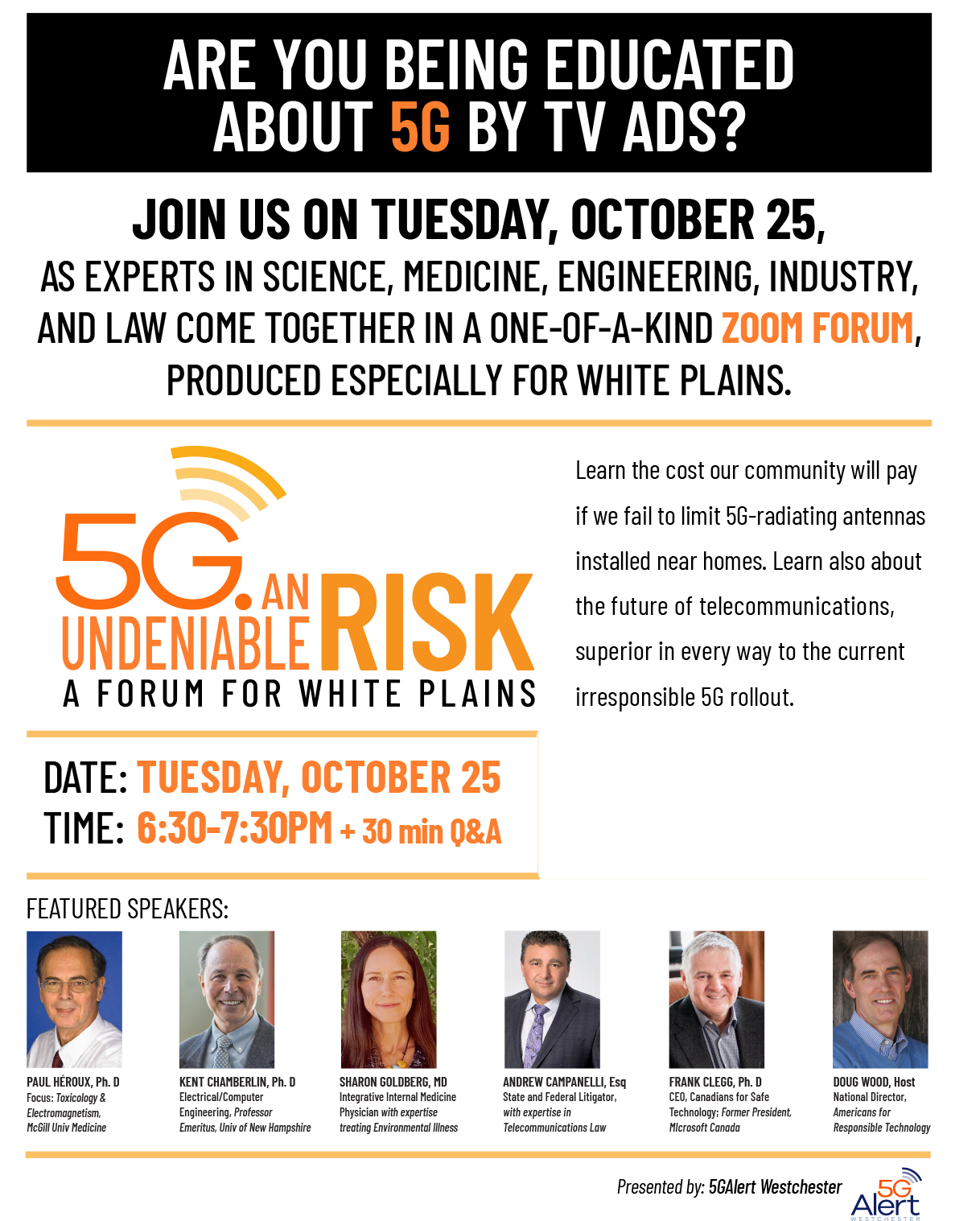
The video of the recent US-based Zoom forum, 5G – An Undeniable Risk, featuring Dr. Paul Héroux, Dr. Kent Chamberlin, Dr. Sharon Goldberg, Frank Clegg and Andrew Campanelli, Esq. is now available for everyone to watch.

Please share widely. This was a power-packed event that brought a group of brilliant panellists together.

The 85-minute video, along with presentation material, can be accessed on Americans for Responsible Technology’s website at:

https://www.americansforresponsibletech.org/5gwebinar

Posted in 5G | Tagged , , , , | 2 Comments

Zoom Forum | 5G – An Undeniable Risk

Stop Smart Meters Australia members and supporters are invited to join the following US-based forum on 5G risks.

With its impressive line-up of speakers, the forum promises to be highly informative and engaging.

Note that the time of the forum for residents in Canberra, Melbourne and Sydney is 9.30 AM, Wednesday, 26 October 2022.

Click here to register for the Zoom forum.

A PDF copy of the 5G forum flyer is available here.

Posted in 5G | Tagged , , | 1 Comment

Power Company Seizes Control Of Thermostats using Smart Meters

Around 22,000 households in Colorado recently lost the ability to control their thermostats after the power company seized control of them during a heatwave.

After temperatures soared past 90 degrees, residents were left confused when they tried to adjust their air conditioning and found locked controls displaying a message that said “energy emergency.”

Xcel confirmed to local news station Denver7 that “22,000 customers who had signed up for the Colorado AC Rewards program were locked out of their smart thermostats for hours on Tuesday.”

“I mean, it was 90 out, and it was right during the peak period,” Tony Talarico told the news station. “It was hot.”

Talarico said he is normally able to override the “energy emergency” message, but not on this occasion.

Completely losing control over the temperature of your own home is presumably one of the many benefits of the smart meters people will be forced to endure.

This story is yet another example of how smart meters will pave the way for energy rationing.

No doubt people who have them installed will increasingly find their thermostats remote controlled at the behest of energy companies whenever a dubious ‘crisis’ can be declared.

And if that sounds bad, just imagine what will happen if net zero green energy ‘climate lockdowns’ become normalised.

People in major European countries are already having their thermostats regulated.

Another reason to keep your house technology ‘dumb’ and disconnected from the wireless smart meter network if you want to maintain control over the temperature in your home.

Abridged from: https://www.zerohedge.com/technology/power-company-seizes-control-thermostats-colorado-during-heatwave

Posted in disconnection, Electromagnetic radiation, electronic models, EMF, EMFs, Smart Meter | 2 Comments

Event | 5G & EMF Workshop, Sydney, 17 July 2022

There will be seating for 60 available at the following workshop. The event is being recorded and will be available for viewing afterwards on the Oceania Radiofrequency Scientific Advisory Association’s  (ORSAA) website at https://www.orsaa.org/.

Posted in EMFs | Tagged , , , , , , , , , , , | Leave a comment

International Electromagnetic Hypersensitivity (EHS) Awareness Day – 16 June

The aim of this day is to inform the general public about the different sources of artificial electromagnetic radiation (EMR) they are confronted with on a daily basis and to explain how to avoid unnecessary exposure to them. We need to create more awareness of EHS, the health effects of EMR exposure and to support people suffering with EHS.

At present, many EHS people are suffering alone; let’s show solidarity, think of them and give these people the visibility they deserve. 

Because of lack of awareness and official medical acknowledgment most sufferers of EHS don’t understand the cause of their symptoms and continue to use EMF-emitting devices. Some develop different theories to explain their condition and symptoms, are often mistreated and undergo medical procedures that in some cases can even make their EHS condition worse.

The lack of awareness and official acknowledgment leads to more people suffering from EHS as EMR usage continues uninterrupted and with people not taking precautions.

While industry continues to profit from the uptake of polluting technologies, more and more people are becoming sensitive to EMR and electromagnetic fields (EMF), and more people with EHS will continue to suffer. Improvement in the EHS condition of a person will most likely occur after a few days/weeks of exposure reduction. This can happen only if an EHS person understands the source of his/her symptoms and is willing to take steps to stop their use and reduce exposure. The lack of acknowledgment, both by medical professionals and government, not only makes it harder for EHS to be accepted, but also makes it more difficult for people to find out the cause for their symptoms. These people unknowingly continue to use their devices and continue to be exposed to EMR, while their condition deteriorates.

EHS awareness day was created to change this.

Articles and ideas to support this day can be found at:

http://coeursdehs.fr/all-about-the-ehs-day-2022/

Electromagnetic Hypersensitivity awareness day 16/6/2021

Posted in Smart Meter | Tagged , , , , , , , , , | 1 Comment

Australia’s electricity grid increasingly vulnerable to hackers via solar panels, smart devices

The widespread adoption of rooftop solar panels and smart appliances is increasing the risks of cyber attacks on Australia’s electricity grid.

Russia’s invasion of Ukraine has heightened fears Moscow could take the war into cyberspace as it seeks to retaliate against the West over massive and unprecedented economic sanctions.

Two of Australia’s top cyber security advisors said the electricity networks of Russia’s adversaries would be firmly in sight as part of any attack and Australia was not immune. 

Their comments came amid warnings that Australia’s embrace of rooftop solar and technologies that communicate with the grid through the internet could make the country more vulnerable to hackers.

One of Australia’s leading energy regulators acknowledged the need for electricity networks to boost spending on cyber security to help safeguard the grid.

Alastair MacGibbon, the chief strategy officer at consultancy CyberCX and a former cyber security advisor to the federal government, said the risks were growing as the electricity system became more complex.

Cyber risks to grid ‘catastrophic’

“The more connected you are the more important cyber security is,” Mr MacGibbon said.

“We rely upon those connected devices that make up our society to function to the point now where there would literally be potential loss of life, potential catastrophic, cascading effects on the very functioning of society if we don’t get cyber security right.

“That sounds like a sky-is-falling type of statement.

“But it’s just a reality when our transport, our power, our water, our banking, the way we communicate with each other, literally the way everything functions, relies on a connected device.”

Last year, Queensland electricity generator CS Energy was almost brought to its knees after criminal Russian hackers hit the company with a devastating ransomware attack.

Such attacks involve hackers infiltrating a company’s computer systems and threatening to destroy or withhold critical information unless the victims pay a ransom.

Frequency of attacks ‘astonishing’

Cyber Security Cooperative Research Centre chief executive Rachael Falk said the CS Energy attack was a serious incident that almost disabled electricity provision in one of Australia’s biggest states.

But she said it wa far from isolated.

“It is a common story,” Ms Falk said.

“Ransomware is one of the biggest threats we have at the moment to our organisations and we know that particularly electricity and industrial companies are a main target.

“It’s the equivalent of having a tsunami through your business — it’s ruined everything, there is nothing left untouched, it’s devastating.”

According to Ms Falk, one of the most common ways for hackers to get into a company’s systems was through “phishing” emails, which might be disguised as bills or notifications.

She said cyber criminals were becoming increasingly sophisticated in their design of phishing emails.

They were also becoming more nimble.

“Cyber criminals are very adaptable,” Ms Falk said.

“During COVID, we saw a quick spike in mimicking official government emails, say about JobKeeper or JobSeeker.

“Within hours they had pivoted to mimic, and very convincingly mimic, official government emails with lures … in order to dupe people.”

Households are unwitting targets

Mr Edwell said the rapid uptake of solar and smart appliances, such as internet-enabled fridges and air conditioners, had been a boon for consumers, lowering bills and giving them greater autonomy over their needs.

Nevertheless, he said there were downsides from a security point of view, noting that households had potentially become entry points through which hackers could infiltrate the network.

“So, here in WA … we’ve got [one] third of households now with solar [photovoltaic cells],” he said.

“You have these two-way flows of generation back into the system.

“The challenge that network businesses have now is much greater than in the past.

“And the way they do that is to digitalise, automate.

“The more you have of that, the more your system is open to cyber-attack.

“We now have inverters in … households in Perth and surrounds all ultimately talking to the network business.

“That’s where the risk comes in.”

Abridged from: https://www.abc.net.au/news/2022-03-14/australia-electricity-grid-vulnerable-hackers-solar-panels-smart/100892044

Posted in Smart Meter | 1 Comment

New documentary on 5G and health premieres: ‘Something is in the Air’

Is radiation from your mobile phone or telecommunication towers harmful for your health?  Or the environment?  

Are scientific conclusions tied to the interests of those who fund the studies?  How do governments make sure the radiation stays within healthy limits?  What happens to insects when 5G is fully rolled out?

These questions and many more are explored in Something is in the Air.  Interviewees include scientists such as Dariusz Leszczynski and Martin Pall.  This outstanding documentary provides a comprehensive overview of many of the important issues around the increasing saturation of our environment with pulsed radiofrequencies.

The 28-minute video can be accessed for free below or at the following link: https://youtu.be/Q89Gv2P3RH8

Posted in Electromagnetic radiation | Tagged , , , , , , , , , , , , , | 3 Comments

‘Havana syndrome’ blamed on pulsed microwaves | BBC News

The UK’s national broadcaster, the BBC, has been told that there are now hundreds of reports of ‘Havana syndrome’, spanning every continent.  Described as a mysterious illness that has struck American diplomats and spies, it first emerged in Cuba in 2016. 

BBC security correspondent, Gordon Corera, says that, ‘It often started with a sound, one that people struggled to describe. “Buzzing”, “grinding metal”, “piercing squeals”, was the best they could manage.’  

Illustration by Gerry Fletcher, BBC News

A December 2020 report from the US National Academies of Sciences, Engineering and Medicine concluded, after considering other causes, that ‘directed, pulsed radio frequency energy appears to be the most plausible mechanism in explaining these cases…’.  The news release on the report described symptoms such as a perceived loud noise, ear pain, intense head pressure or vibration, dizziness, visual problems, and cognitive difficulties.  It stated that in some cases these suddenly occurred and that many sufferers still continue to experience these or other health problems.

SSMA notes that pulsed microwaves are also emitted by wireless smart meters.  In Australia, meters are often placed on the outside of bedroom walls, in close proximity to where people sleep.  As pointed out by Physicians for Safe Technology, the health effects experienced by diplomats and their families mirror those of individuals who have developed electrosensitivity (EHS) or electromagnetic illness following exposure to pulsed radiofrequency radiation from wireless devices.

To read the BBC News article, titled ‘Havana syndrome’ and the mystery of the microwaves’, go to: https://www.bbc.com/news/world-58396698

To read the National Academies of Sciences, Engineering and Medicine’s December 2020 news release and report titled ‘An Assessment of Illness in U.S. Government Employees and Their Families at Overseas Embassies (2020), go here.

Posted in Smart Meter | Tagged , , , , , , , , , | 3 Comments

Payphones are now free phones

Telstra announced earlier this month that charges no longer apply to local or national calls to a fixed line or Australian mobile number from payphones.  This means that anyone can now use one of the 15,000 payphones still remaining across Australia for free.

Telstra phone booth

Telstra CEO, Andrew Penn, said that a lot of Australians might not give payphones much thought.  Until there’s a natural disaster.  Or until they are in vulnerable circumstances, homeless or fleeing domestic violence.  SSMA pointed out in 2017, in our response to the Telecommunications Universal Service Obligation Inquiry, the folly of relying on wireless infrastructure for voice communications.  This is echoed by Mr Penn, who states, “I’ve seen queues of people waiting in line, coins at the ready, to use a payphone to call home and tell their family and friends they’re safe after a bushfire, a cyclone or some other natural disaster has taken the mobile network down”.

Removing charges at payphones also provides a lifeline to vulnerable Australians.  Salvation Army Major Brendan Nottle is quoted as saying that making payphones free is a “game changer” for people who can’t afford a mobile phone, or have had to leave dangerous domestic situations.

Payphones are provided by Telstra as part of its contract under the Universal Service Obligation (USO).  The USO legislation is aimed at providing all Australians with reasonable access to payphones and standard telephone services on an equitable basis. Telstra is paid $40 million per annum for maintaining the payphone network and $230 million per annum to maintain its copper network outside of the NBN fixed line footprint.

The USO runs through until 2032 but, in 2016, was made subject to a 12-month inquiry to reassess its value.  The Productivity Commission was tasked with examining the relevance of the USO, given the rollout of the National Broadband Network and the public’s uptake of competing technology.  Not surprisingly, other telecommunications companies, who are obliged to help fund the scheme, were keen to see its demise. 

The Productivity Commission’s final report echoed these sentiments, describing basic telephone and payphone services as “anachronistic and costly” and in need of being wound up by 2020.  Thankfully, this blinkered verdict from the Productivity Commission was not accepted by the government’s 2018 Regional Telecommunications Review committee, which noted that, “For many living in rural, and particularly remote Australia, Telstra’s fixed voice service is the only connection to the outside world if their internet service is not working”.  Unlike the Productivity Commission, this committee was prepared to take on board concerns raised by people and therefore recommended a measured and cautious approach to any changes to the USO arrangements.  In consequence, the government backtracked on its intention to scrap existing USO provisions by 2020.

SSMA applauds Telstra on its initiative to make payphones free.  Dropping payphone charges also looks like a win-win for Telstra, which will now be freed from the costs associated with coin collection. 

The importance of wired connections is finally being recognised; however, it is unfortunate that some of Telstra’s payphones host WiFi connectivity, which may render such phones unsuitable for use by people with EHS.  

It remains to be seen whether the recent death spiral that payphones have found themselves in will be reversed, now that payphones are free phones.  Given the inherent vulnerability of wireless communications, along with its contribution to electrosmog and carbon emissions, SSMA hopes that the introduction of free public phones will spur a revival in their usage!

Posted in Universal Service Obligation | Tagged , , , , , , , , , , , , , , , , | 7 Comments