
Back in the good old days, before smart meters, before the privatisation of the Victorian Electrical system, there was the state government owned State Electricity Commission of Victoria. The SECV was disbanded in 1993 as various private electricity companies (largely foreign owned) scrambled for a piece of the lucrative action. See Vicpower website.
The SECV used to send its customers a periodic ‘Customer News’. 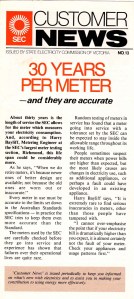 In the issue distributed around about 1993, the year of the SEC’s demise (and the issue’s number is ominously ‘No. 13’) the SECV was at pains to assure its customers that their (analogue) electricity meter is accurate and within the limits set down in the Australian Standards specifications. Was this assurance prophetic, foreseeing the introduction of smart meters to Victoria under a privatised electricity network?
The rollout of smart meters in Victoria saw complaints to the Energy and Water Ombudsman of Victoria (EWOV) go through the roof. The private electricity distributors in Victoria claim that the skyrocketing electricity consumption of many customers who‘ve just received a smart meter is due to the smart meters being accurate and analogue meters being inaccurate. Not according to the SEC’s newsletter. Which meter is accurate?
The SECV newsletter goes on to say that their meters “can be expected to stay inside the allowable range throughout its working life”. Are smart meters accurate for even one day? Customers in Victoria and around the world report their bills nearly doubling, and sometimes even more, from day one of having a smart meter installed.
The SECV in its 13th newsletter also tells customers that their analogue meter will last 30 years and more. That’s fairly indisputable. Some of those who were smart enough to retain their analogue meter have a meter that is possibly 70 years old.
Not so the ‘smart’ meter. It has an optimistic lifespan of about 15 years. “Given there is limited real experience to draw from, we considered it reasonable to assume that the meters will be replaced 15 full years after they were installed in the mass rollout”, quoted from ‘Advanced metering infrastructure cost benefit analysis’. And it won’t be the foreign owned electricity distributors who will be footing the bill when the smart meter needs replacing. It will be the customers. No financial loss to the electricity distributor.
The SECV newsletter goes on to say that failures of analogue meters “over their operational life are quite rare”. Not so with smart meters. All it takes is a common occurrence like a vehicle hitting a power pole for hundreds of local smart meters to simultaneously explode. See ‘Hundreds of smart meters simultaneously explode’ Ask those residents what they thought of the smart grid’s ability to quickly detect and rectify blackouts.
Which meter lasts longer, measures accurately to Australian standards and is less likely to fail? You don’t have to be very smart to figure that one out.




 Stop Smart Meters Australia