
French-based organisation Phonegate Alert has been exposing systemic fraud in how smartphones are tested since 2017.
The organisation is headed by physician Dr Marc Arazi, whose protracted legal action resulted in France’s National Frequency Agency (ANFR) being forced to make public in 2017 earlier damming test results on hundreds of phones. These showed that nine out of ten of the phones tested exceeded the manufacturer’s reported radiation test levels when re-tested in positions close to the body.
As a result of Phonegate’s efforts over sixty mobile phone models have now been either withdrawn from the French market or had software revisions due to danger to users’ health.
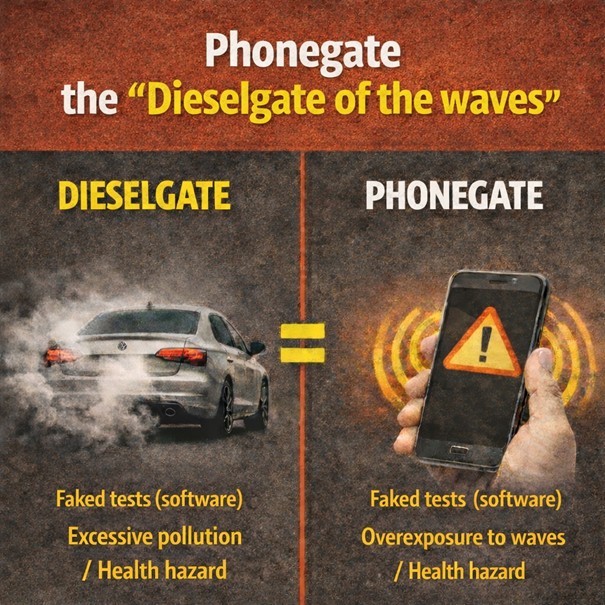
Phonegate Alert, whose name is a play on the Volkswagon emissions scandal, has amassed evidence on how mobile phone manufacturers are deploying systemic cheat software to ensure that radiofrequency emission levels meet regulatory standards when tested.
For instance, they claimed that Apple used its ‘Body Detect’ software to intentionally reduce power to pass tests on the Apple iPhone 12 A2403. Apple rebuts this, maintaining that if motion isn’t detected, then it is safe for the phone to exceed regulatory limits as the device is assumed to not be in contact with the human body. Unlike France’s authority, which wasn’t convinced by this logic, along with the European Commission, which upheld France’s decision, Australian authorities swallowed Apple’s justification hook, line and sinker. Despite this, Apple now says it has extended the software fix required for the French market to reduce power levels, even when not considered to be in contact with the human body, to all regions.
Other means by which Phonegate says manufacturers can use embedded phone software to gain favourable test results include smoothing out emission peaks using time averaging algorithms and adjusting the power through proximity sensors. We don’t know the full extent of fraud as manufacturers are refusing to provide deactivation keys for embedded software at the time that testing is done.
Dr Arazi’s book PHONEGATE: Overexposed and deceived – What the cell phone industry doesn’t want you to know, which had its English release in 2022, recounts his herculean efforts to expose the truth about how regulators and the public are being hoodwinked by mobile phone corporations.
The irony is that the standards that phone manufacturers are required to adhere to, and which they appear to often resort to fraudulent practices in order to meet, are themselves a joke.
Our regulatory body, the Australian Communications and Media Authority (ACMA), bases exposure limits to radiofrequency electromagnetic energy (RF EME) on the Australian Radiation Protection and Nuclear Safety Agency’s standard for RF exposure. These limits in turn are based on the recommendations of a private body based in Germany that has bestowed upon itself the lofty title of International Commission on Non-Ionizing Radiation Protection (ICNIRP), and which has stood accused of harbouring conflicts of interest.
ICNIRP remains loyal to an archaic means developed in the 1990s to estimate the Specific Absorption Rate (SAR) from mobile phone radiation. The crude methodology utilises a mannequin bearing a head into which liquid and then a probe can be inserted to measure heating due to exposure to mobile phone radiation. This dummy, dubbed SAM (‘Standard Anthropomorphic Man’ or ‘Specific Anthropomorphic Mannequin’) doesn’t have a lot in common with the average person. SAM was modelled on the size and mass of the top ten percent of US military recruits in 1989, has a ‘head’ only capable of holding fluid, and which lacks the normal interplay of bone, fat and tissue, and is assumed to use a mobile phone for no more than six minutes at a time.
Possibly SAM provided a legitimate preliminary attempt to guess radiation effects at a time when mobile phone usage was not ubiquitous. Users with smaller heads and thinner skulls, in particular children, didn’t need to be accounted for, and the many documented effects that are unrelated to heating were not as widely known.
However, in this day and age, it would appear that only a buffoon would give credence to such a farcical testing methodology.
SSMA salutes Phonegate Alert on its tenacity in casting light on the widespread use of cheat software by mobile phone manufacturers to meet regulatory limits. As with Apple’s iPhone, the benefits of enforced reduced radiation levels in France, can also lead to improved safety for mobile phone users in Australia.
We look forward to the day when regulators fearlessly regulate. We need them to ensure transparent compliance with standards. And more than that, we need regulators to choose robust standards by which to measure compliance – and not ones such as the flawed and outdated standard that the ACMA relies on today to protect Australians from harm from pulsed microwaves.


 Stop Smart Meters Australia
I have a smart meter with its side facing my bedroom. Does it radiate only front and back or sides as well? Sorry if it’s a silly question
My smart meter antenna, which is in the smart meter, is an omnidirectional one. I assume they are all the same, even if external?? I got my smart meter moved because it was on the bedroom wall. It cost heaps but was worth it.
Why not ask your electricity provider to confirm in writing the directions it is radiating?
I’m in Australia and the meter is on the other side of the wall of my bedroom !!!! Elfie 🌸
Might you be able to sleep in another room?